Most regulated businesses have some version of a self-check plan on paper. A review here, a checklist there, something that looked reasonable when it was written. The trouble shows up later, during a busy season or a stretch of turnover, when the plan quietly stops happening and nobody notices until an outside inspection does. By then the gap is rarely one missed check. It is a run of missed checks on the same blind spot.
A review schedule that keeps running under real conditions does three things. It sets frequency from requirements and risk, it gives each check an accountable role, a named assignee, and a backup, and it makes a skipped check visible. It also keeps two kinds of review separate: self-checks by the people doing the work, and independent review by someone who does not.
Self-checks and independent review do different jobs
Operational self-checks are run by shift leads and site managers. They confirm that the procedure is being followed today: the opening checklist was completed, IDs are being checked as the procedure requires, the log was filled in.
Independent review is done by someone outside the site’s day-to-day reporting line, such as a compliance lead from elsewhere in the business, the owner, or an outside reviewer. It tests whether the self-checks happened, whether they would catch a real problem, and whether sites are drifting apart.
Neither replaces the other. Neither is the same as an inspection or audit a regulator conducts, or a financial audit by an accountant. Where a rule, license condition, or permit requires particular reviews or records, that requirement sets the minimum, and your internal schedule builds on it.
Set frequency from requirements and risk, not habit
Set review frequency from applicable requirements, changes, deadlines, and the consequences of a missed control. A few questions help for each item:
- Is a frequency required? If a rule, license condition, or permit sets one, that is the floor. Record the source.
- How quickly would a miss cause harm? A control at the point of sale matters sooner than an annual policy review.
- What changes between checks? Items that change by the shift need closer attention than items that change once a year.
- What deadline is coming? A renewal or report due date may call for a review ahead of it.
- What has gone wrong before? Past findings and near misses justify closer attention for a period.
Agree a cross-site review schedule appropriate to risk and capacity. A schedule nobody has time to run is weaker in practice than a lighter one that actually happens.
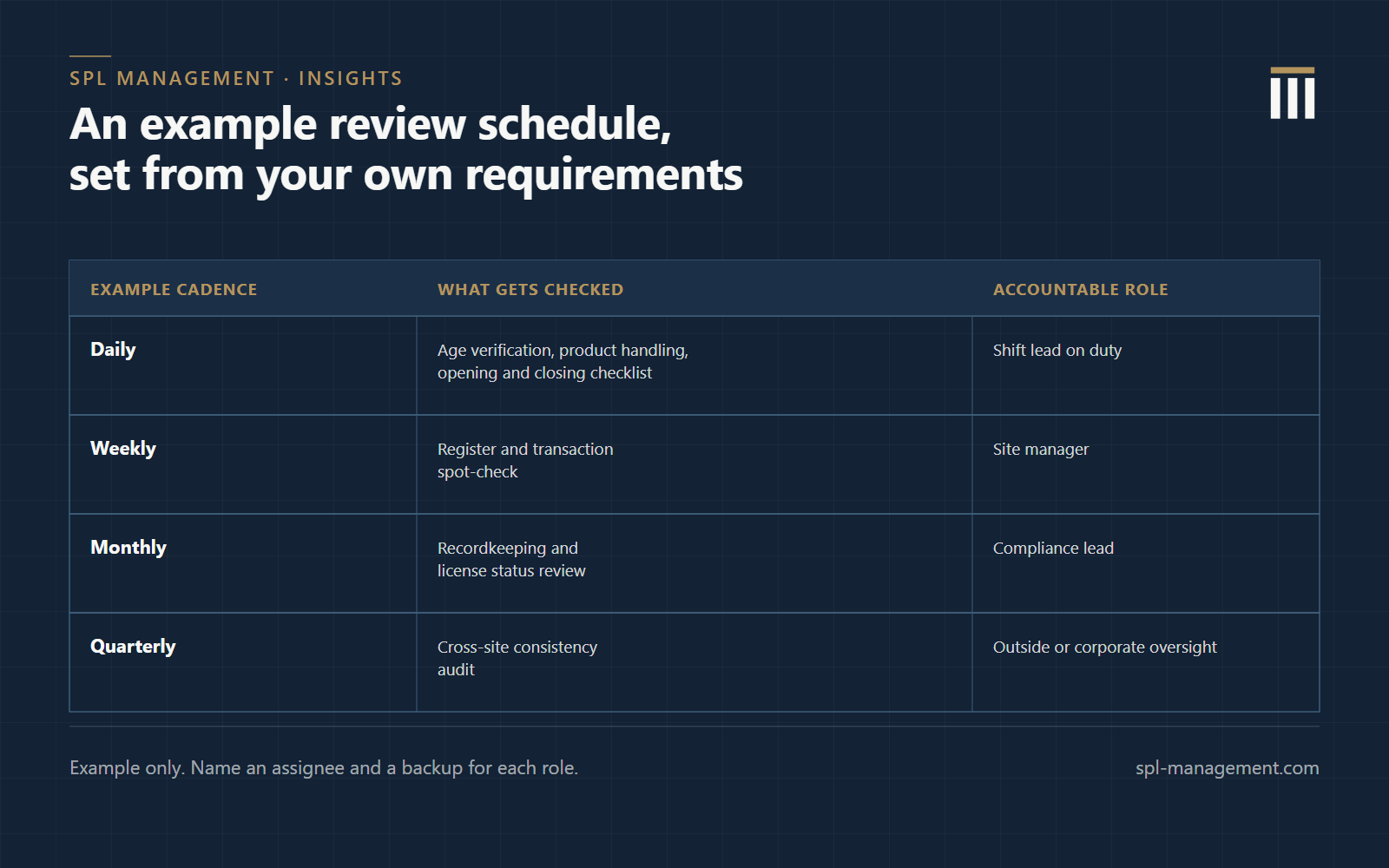
For illustration only: a two-site retailer might settle on counter checks each shift by the shift lead, a weekly records spot-check by each site manager, a monthly license and permit status review by its compliance lead, and a cross-site review each quarter. Another business, with different rules, risks, and staffing, could reasonably land somewhere else.
Assign an accountable role, a named assignee, and a backup
A check owned only by a person lapses when that person leaves. A check owned only by a role can lapse too, because nobody is sure who is filling the role this week. Use both: an accountable role, the current named assignee, and a backup who covers absences.
Responsibility does not move by itself when people change. Transfer it explicitly during onboarding and handover, and record the new assignee. The SOP Template already has fields for a responsible role and a named document owner, and the Training Matrix and Sign-Off Log records who has been trained to run each check. For multi-site operators, this is part of keeping one written standard across locations.
A review schedule that depends on someone remembering to run it is a to-do list with a due date nobody checks.
Make a skipped check visible
A schedule that depends on someone remembering to fill out a form tends to lose to a busy week. A schedule that produces a visible gap when a check is missed, such as an empty row in a shared log or a flag to a manager, gives someone above the day-to-day operation a chance to catch the lapse before it compounds. The aim is that a miss does not sit unnoticed long enough to become the norm.
This is where many well-intentioned schedules fail. The checklist exists, staff know it exists, and it still stops because nobody outside the site is looking at whether completed checklists are arriving. A schedule needs a second layer: someone whose job includes noticing the absence of a record, on an agreed timetable.
Purpose-built software helps at scale but is not required. A shared log with a fixed structure, such as the Monthly Site Walk-Through for site reviews, and a named reviewer can do the same job at a single site. Where records live, and how quickly they can be retrieved, is covered in regulated retail recordkeeping.
Close the loop on what the checks find
A check that finds a problem is only useful if the problem gets fixed and the fix is confirmed. Log each finding on a Corrective Action Log with an owner and a due date, keep it open until someone other than the person who fixed it has verified the fix, and track overdue work separately from overdue verification.
What a schedule that holds gives you
The value of a review schedule that survives a busy quarter is what the business learns from it: which sites are drifting from the standard, which staff need more training, and which issues can be corrected before they surface during someone else’s inspection. That knowledge exists only if the checks happened and were written down.
It also changes how an outside inspection feels. A business that has been checking itself on an agreed schedule is less likely to be surprised by what a regulator raises, because many issues will already be on its log.
There is a quieter benefit as well. Staff tend to work more consistently when they know a check happens on a predictable schedule, much as a store keeps shelves in better order when a manager walks the floor each morning. The schedule becomes part of what keeps standards steady between checks.
Talk through your review schedule
SPL Management sets up and runs scheduled compliance and site reviews as part of Compliance Management and Business Operations Management for licensed businesses in the United States and Canada, matched to the sites, staff, and requirements you have. These are operational reviews, not legal or financial audits. A 30-minute consultation is a practical way to talk through your current schedule and whether a scoped review would help.
General information only, current as of the last review on September 26, 2026. Rules vary by jurisdiction and change often. This is not legal, tax, or real estate advice; confirm current requirements with the regulator or a qualified professional before acting. How we write and review articles.
Keep reading
Operations
Vendor and Supplier Vetting for Regulated Industries
· 6 min read
Operations
Point of Sale Compliance: Age Verification and Transaction Records in Regulated Retail
· 6 min read
Operations
One Playbook, Every Location: Standardizing Operations Across Multiple Sites
· 5 min read