Ask a multi-site operator how a routine task gets done, and the honest answer is often “it depends which location.” One site closes out the day one way, another does it differently, and both would defend their version as the right one. Nobody chose this on purpose. It is what happens when procedures live in people rather than in a system, and each site fills the gaps with its own judgment.
In a regulated industry, that variation is not a minor inefficiency. It can be the reason one site passes an inspection cleanly while a similar site two towns over gets written up for the same underlying gap. This article is about the structure of an operations playbook: what it covers, what sits at the center, what each site adds, and how the two layers stay connected.
Standards do not spread on their own
When a business opens its second location, it may staff it with people who learned the job at the first one, so the standard travels along with them for a while. By the third or fourth site, that direct line is gone. New managers are trained by whoever is available, procedures are explained verbally instead of read, and each site’s version of “how we do things” starts to drift from the others without anyone deciding it should.
Head office may not see the drift directly. It shows up sideways: in inconsistent numbers between sites doing similar volume, in an inspection finding at one location that never came up at another, or in a new manager who asks a question that should have had an obvious, documented answer.
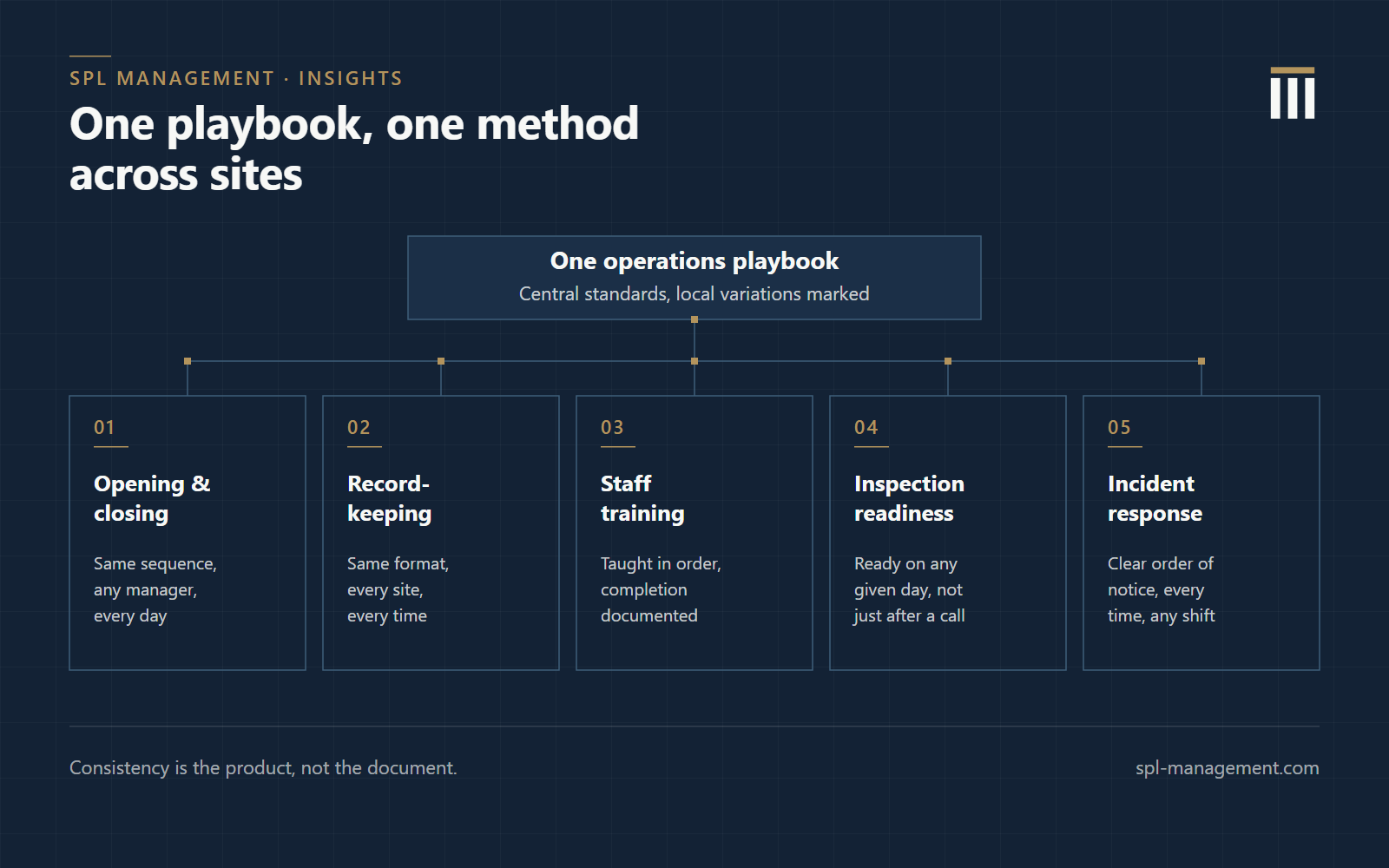
What one playbook actually covers
Opening and closing procedures. The sequence of tasks that starts and ends each operating day, written specifically enough that two different managers produce the same result without improvising.
Recordkeeping. What gets logged, in what format, kept for how long, and where. Retention periods may be set by regulation, a license condition, or internal policy, and the playbook should record which one applies. Consistent formats mean records from each site can be pulled the same way under time pressure.
Staff training. What a new hire is taught, in what order, and how completion is confirmed and documented, so training is not left to whichever colleague happens to be working that day.
Inspection readiness. What should always be true, so that a site is prepared for an unannounced visit on an ordinary day rather than only after a warning call.
Incident response. Who is notified, in what order, and what gets documented when something goes wrong, so that a response does not depend on whoever happens to be the most experienced person on shift that day.
Consistency is not about making each location identical. The method is consistent, while procedures reflect the rules that apply at each site.
A playbook is not the same as a binder
If there is already something in writing, the trouble tends to be one of three things: the document was written once and never updated as the rules changed, it was written by someone no longer with the company and nobody has revisited it since, or it exists but nobody checks that it is actually being followed at each site.
A working playbook is different in three ways. It is reviewed on a schedule, not only after something goes wrong. It is written in plain language a new manager can follow without a translator. And someone is responsible for confirming, through regular site visits or reviews, that what is written matches what is actually happening on the floor.
Central standards, local procedures
Some variation between sites is necessary. A location in a different city or state may face different rules, a license may carry its own conditions, and a landlord may impose site-specific requirements. The playbook handles this with two layers rather than one document per site:
- The central layer applies to all sites and sets the method: the SOP format, who approves changes, the review schedule, record formats and naming, how training is signed off, the incident escalation order, and the schedule of internal checks.
- The local layer is a short site sheet for each location: the licenses and conditions that apply at that address, the state and local rules that differ from the central procedure, local contacts, and any site-only tasks.
- The link between them is a marked variation. Each local change to a central procedure names its source (a regulation, a license condition, a landlord requirement, or an internal decision), names an owner, and is reviewed whenever the central procedure changes.
An illustrative example: the central receiving procedure says deliveries are checked against the order, logged the same day, and signed by the receiving employee. Site C’s license conditions, in this example, set a delivery window and require a second employee to witness receipt. Site C’s version of the procedure keeps the central steps, marks the delivery window and the witness signature as local variations, cites the license condition as their source, and names the site manager as owner. When head office revises the receiving procedure, Site C’s variations are checked against the new version rather than quietly overwritten.
Done well, this structure also makes opening a new site more predictable. It becomes a matter of applying the central playbook and writing one new site sheet, rather than reconstructing standards from memory. The sample procedures show the format for a fictional business.
Where to start
The starting point is not a rewrite of everything at once. It is an honest look at what is actually written down today, what has drifted from it at each site, and which gaps carry the most regulatory or operational risk if they are not closed first. The Standard Operating Procedure Template gives each procedure a named owner and numbered steps, and the Training Matrix and Sign-Off Log records who has been trained on which version.
Standardize before you scale
SPL Management builds and maintains operations standards for multi-site licensed businesses in the United States and Canada through Business Operations Management. If you are working out how to structure procedures across your sites, the consultation is a 30-minute call to talk through where you are and whether SPL fits.
General information only, current as of the last review on September 26, 2026. Rules vary by jurisdiction and change often. This is not legal, tax, or real estate advice; confirm current requirements with the regulator or a qualified professional before acting. How we write and review articles.
Keep reading
Operations
How to Set an Internal Compliance Review Schedule
· 5 min read
Operations
Vendor and Supplier Vetting for Regulated Industries
· 6 min read
Operations
Point of Sale Compliance: Age Verification and Transaction Records in Regulated Retail
· 6 min read