Tenants in regulated industries are used to being investigated. Landlords run credit checks, ask for financials, and want to understand the business before signing a lease. Fewer tenants return the favor, and in a regulated industry the landlord’s own situation can matter as much as the tenant’s. The lease is a two-party document, but most due diligence only looks at one side of it.
A property can look ideal, the zoning can check out, and the rent can be reasonable, and the deal can still run into trouble because of something on the landlord’s side: a lender that has not approved the use, an ownership structure in flux, or a building history that complicates permitting. None of those problems shows up in a walkthrough, and any of them can affect the tenant after the lease is signed.
A note on roles: SPL Management is not a law firm or a real estate brokerage and does not give legal or real estate advice. The checks below are questions to organize and take to your own counsel, who can verify the answers and tell you what they mean for your lease.
Confirm who actually owns the property
Ownership on a listing is not always ownership on the public record. Properties can change hands during a lease negotiation, and a pending sale or a foreclosure can affect a tenant even after a lease is signed. Have counsel assess how a sale or foreclosure could affect the lease and what protections may be available, such as a non-disturbance agreement where one can be obtained.
Ask plainly whether the entity signing the lease is the entity that holds title, or has written authority to sign for it. Management companies and affiliated entities sometimes sign on an owner’s behalf. Have counsel verify ownership, signing authority, and the entity’s obligations before you rely on the signature.
Ask whether the landlord’s lender needs to approve your use
Some commercial mortgages restrict how a property can be used or require the lender’s consent to certain leases, and some lenders restrict particular regulated uses as a matter of policy. Whether any of that applies depends on the landlord’s loan documents, which a tenant usually cannot see without the landlord’s cooperation.
Ask the landlord, in writing, whether its financing requires lender consent for your lease or your use, and ask counsel how to confirm the answer and what to request if consent is required. A verbal “it will be fine” is not the same as a written answer. Required lender consent can address one risk; it does not eliminate financing or tenancy risk. If a lender later objects to a use it did not approve, the consequences depend on the loan, the lease, and applicable law, which is why the question belongs before signing.
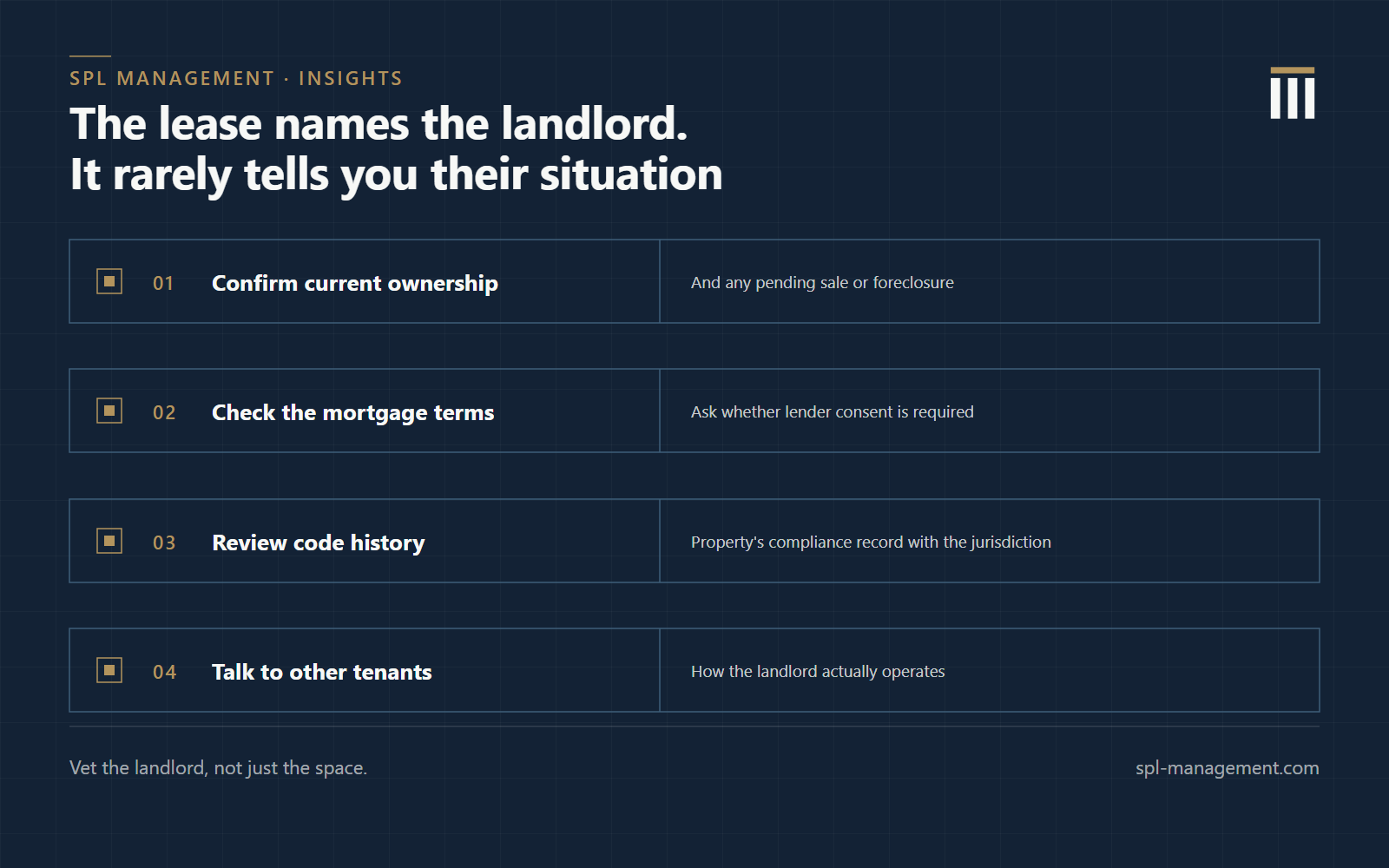
Vetting the space and skipping the landlord leaves half the picture unchecked.
Check the building’s compliance and tenant history
A property with code violations, unresolved inspection findings, or a pattern of short tenancies can tell you something about the building and how it is managed. Some open items, such as unpermitted work or unresolved code violations, may relate to the property itself rather than to a past tenant, and they can affect what a new tenant is able to permit or license there. Check the property’s records with the local building and code enforcement offices, and ask counsel how any open items would be handled under the lease.
Talking to other tenants in the building, when that is practical, often surfaces more than a landlord’s own summary. A property manager who is slow to fix problems for one tenant may not move faster for the next.
Why this gets missed in a fast-moving deal
Landlord due diligence is rarely skipped out of carelessness. It gets skipped because a promising space moves quickly, often with other interested tenants and pressure to sign before someone else does. Reviewing the tenant’s own readiness feels urgent. Reviewing the landlord’s ownership, financing, and history feels like it can wait, because tenants are not used to treating it as part of the same process.
Multi-site operators face a sharper version, since each new market can mean a new landlord the business knows little about. Start these checks early and build time for unresolved questions into the decision timetable.
What a landlord review looks like
A landlord review works best alongside the space walkthrough, before a letter of intent is signed. It confirms ownership from the public record rather than the landlord’s summary, asks in writing whether lender consent is required for the intended use and how it will be documented, and checks the property’s compliance history with the jurisdiction rather than relying on anyone’s description. Counsel then reviews what you found. The Landlord Due Diligence Checklist sets out the questions, and the Lease Review Checklist organizes the lease terms to raise with counsel.
The landlord review is one part of a wider sequence. Choosing a location for a regulated business covers the order of checks before signing, and local moratoriums and caps covers whether a market is open to a new license at all. If you already occupy the space, lease renewal preparation covers the file to have ready before the term ends.
Before you commit to a landlord
SPL Management organizes property and landlord information for licensed tenants as part of Real Estate & Facilities Management in the United States and Canada, working alongside your broker and counsel. If you are weighing a site, a 30-minute consultation is a practical way to talk through what to gather before you sign.
General information only, current as of the last review on September 26, 2026. Rules vary by jurisdiction and change often. This is not legal, tax, or real estate advice; confirm current requirements with the regulator or a qualified professional before acting. How we write and review articles.
Keep reading
Real Estate
Lease Renewal Preparation for Cannabis and Tobacco Retailers
· 5 min read
Real Estate
Local Moratoriums and Caps: What They Mean for Expansion Plans
· 6 min read
Real Estate
Multi-Site Facilities Compliance: What Belongs in Each Site File
· 6 min read