A shared spreadsheet, reminders in someone’s phone, a wall chart in the back office listing renewal dates: these are all calendars of a kind. A compliance calendar is something more specific. It is one list of the obligations the business has identified, in one place, with a source, a named owner, a backup, and a start date for each.
This article shows how to build one: what belongs on it, what a completed entry looks like, who should own it, and how to set lead time so that preparation starts before the due date rather than on it.
A reminder is not a calendar
The distinction matters more than it sounds. A reminder tells one person that one thing is due on one date. A compliance calendar is an inventory of the obligations the business carries, reviewed and maintained as a system, with visibility that does not depend on any single person remembering to check their phone.
A set of individual reminders spread across different people, tools, and sites works until the person holding one of them is on leave, changes roles, or leaves the company. At that point, the obligation they were tracking can become invisible to everyone else until it is overdue.
What belongs on it
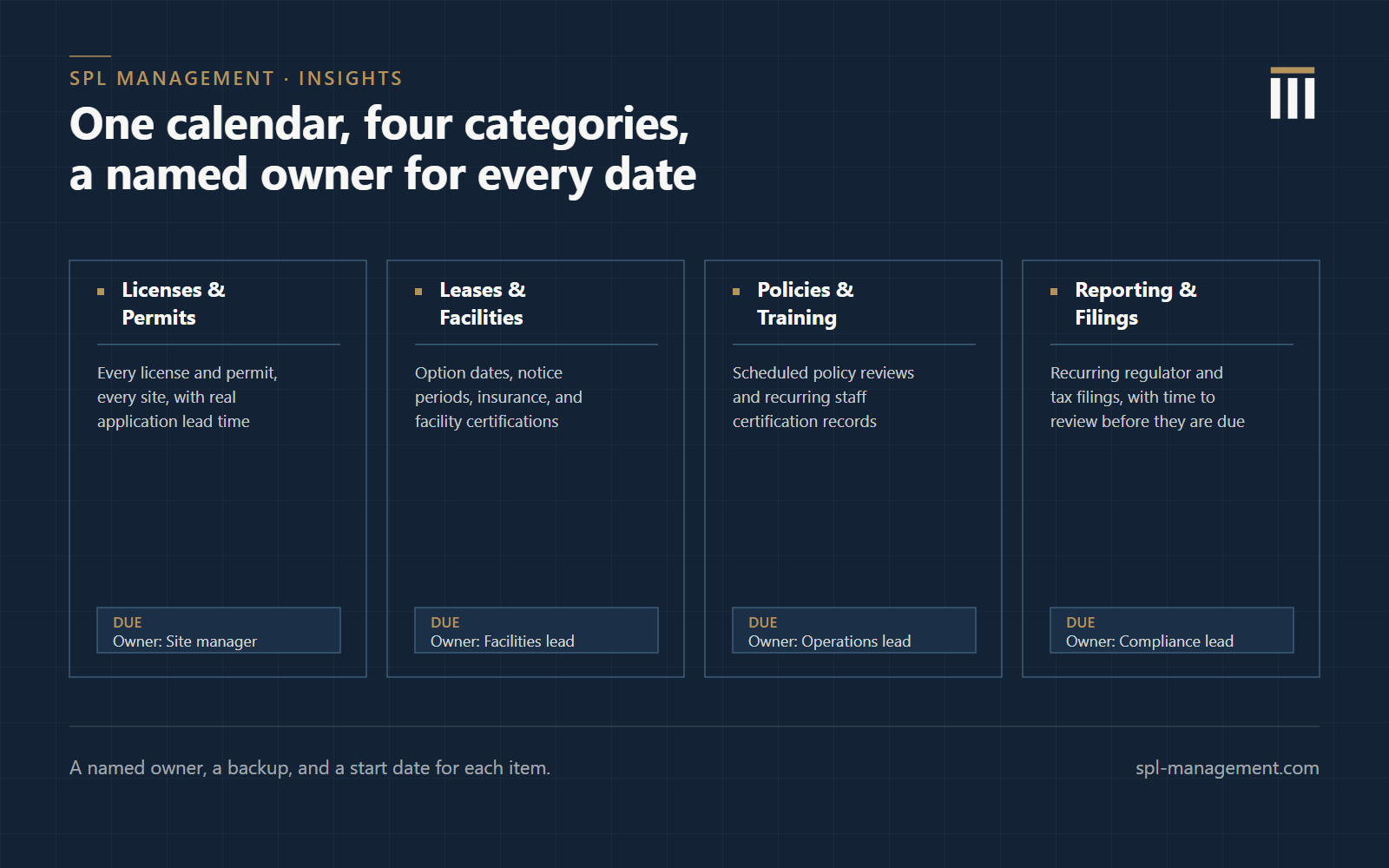
Licenses and permits. Each license and permit the business holds, at each location, with the renewal window and the lead time the application actually requires, not just the deadline itself.
Leases and facilities. Option dates, renewal notice periods, insurance certificate renewals, and any facility inspection or certification the space requires on a recurring basis.
Policies and training. Scheduled reviews of written procedures, and recurring staff training or certification requirements with a record of who has completed them.
Reporting and filings. Recurring submissions to a regulator, taxing authority, or licensing body, with enough lead time built in to review the filing before it goes out, not just enough time to file it.
The Compliance Calendar Checklist is a starting list of common obligations to confirm for your business, which helps find what is missing from the list you already have.
What a completed entry looks like
Each line on the calendar answers the same set of questions. Here is one entry, filled in for a fictional business:
- Obligation: annual renewal of the state retail license for Site B
- Source: the current license certificate and the licensing authority’s renewal instructions, both saved in the Site B license folder
- Due date: March 31
- Start date: January 15, set by the business after reviewing how long the previous renewal took to prepare
- Owner: the operations lead, currently J. Rivera
- Backup: the Site B manager, currently M. Okafor
- Evidence: the submitted application, the payment confirmation, and the renewed license, saved to the Site B license folder with the date each was received
- Next occurrence: added to the calendar as soon as the renewed license arrives, using the new expiry date on the certificate
Illustrative only: the business, people, and dates are fictional. Renewal windows and filing requirements come from the license and the authority that issued it, which is why the source field matters. It tells the next person where to confirm the date rather than trusting the calendar alone.
A compliance calendar is not a list of deadlines. It is a list of obligations, each with a source, an owner, and a start date, reviewed as a system rather than remembered by any single person.
Ownership matters more than the tool
A calendar built in a spreadsheet and reviewed each week by someone accountable for it can outperform an expensive compliance platform that nobody checks. The tool matters less than two things. Each date has an accountable role, a current named person, and a backup, rather than a department. And someone reviews the whole calendar on a fixed schedule to confirm that nothing has fallen out of date or into a gap between two people’s responsibilities.
That second part is easy to skip. Individual owners can track their own items well. What gets lost is the step back: someone whose job includes confirming that the whole calendar is still accurate, that obligations from a new site or a new regulation have been added, and that departed employees’ items were reassigned rather than left orphaned.
Set a start date, not only a due date
A calendar that only marks the due date leaves no room for error. Renewals, filings, and reviews take preparation time, and a due date with no start date attached means the work begins the day it is due, which can be too late to catch an error or gather a missing document. A working calendar marks the date preparation should begin as well as the date something is owed.
The start date is a judgment, not a rule. Set it from how long the task took last time, how many people need to review it, and whether any document has to come from someone outside the business.
What it does and does not do
A compliance calendar will not prevent every finding. It addresses one specific gap: an obligation nobody was actively watching because it was assumed to be someone else’s job. With a start date on each item, it also allows time to prepare and review filings before they are due.
To build your own, the Compliance Calendar Template has columns for sources, owners, backups, and lead times, plus a review log for the whole-calendar check. The sample compliance calendar shows a filled-in version for a fictional business.
Keeping the calendar current
SPL Management builds and maintains compliance calendars as part of ongoing Compliance Management for licensed businesses in the United States and Canada, covering the obligations identified and included in each engagement. If you would like to talk through the calendar you have today, the consultation is a 30-minute call.
General information only, current as of the last review on September 26, 2026. Rules vary by jurisdiction and change often. This is not legal, tax, or real estate advice; confirm current requirements with the regulator or a qualified professional before acting. How we write and review articles.
Keep reading
Compliance
How to Prepare for a Surprise Regulatory Inspection
· 6 min read
Compliance
Regulated Retail Recordkeeping: Retention, Access, and Audit Evidence
· 6 min read
Compliance
California vs. Oregon Tobacco and Nicotine Retail Rules
· 7 min read