Nicotine pouches, vapor products, and traditional tobacco often sit on the same counter, and a retailer adding a new product line tends to assume the existing license and shelf rules already cover it. In California and Oregon, that assumption needs checking. Both states changed their rules recently: California’s Attorney General published the first Unflavored Tobacco List on December 31, 2025, and Oregon’s Senate Bill 1571 took effect on June 5, 2026.
This post compares the two states on four questions a retailer has to answer for each location: which license applies, which products the rules cover, which products may be sold, and what the city or county adds. It reflects the official sources listed at the end as of September 26, 2026. It is general information, not legal advice, so confirm current requirements for each product and location with the relevant agency or your counsel before relying on it.
The federal baseline
Under federal requirements described by the FDA, retailers may sell tobacco products only to customers 21 or older and must check the photo ID of anyone under 30 who tries to buy one. Since April 14, 2022, federal law has allowed the FDA to regulate tobacco products containing nicotine from any source, including synthetic nicotine, and retailers must not sell those products to anyone under 21.
Federal definitions apply to federal requirements. State and local definitions, licenses, and product restrictions have to be checked separately, and that is where California and Oregon diverge.
California: a state license, plus any local license
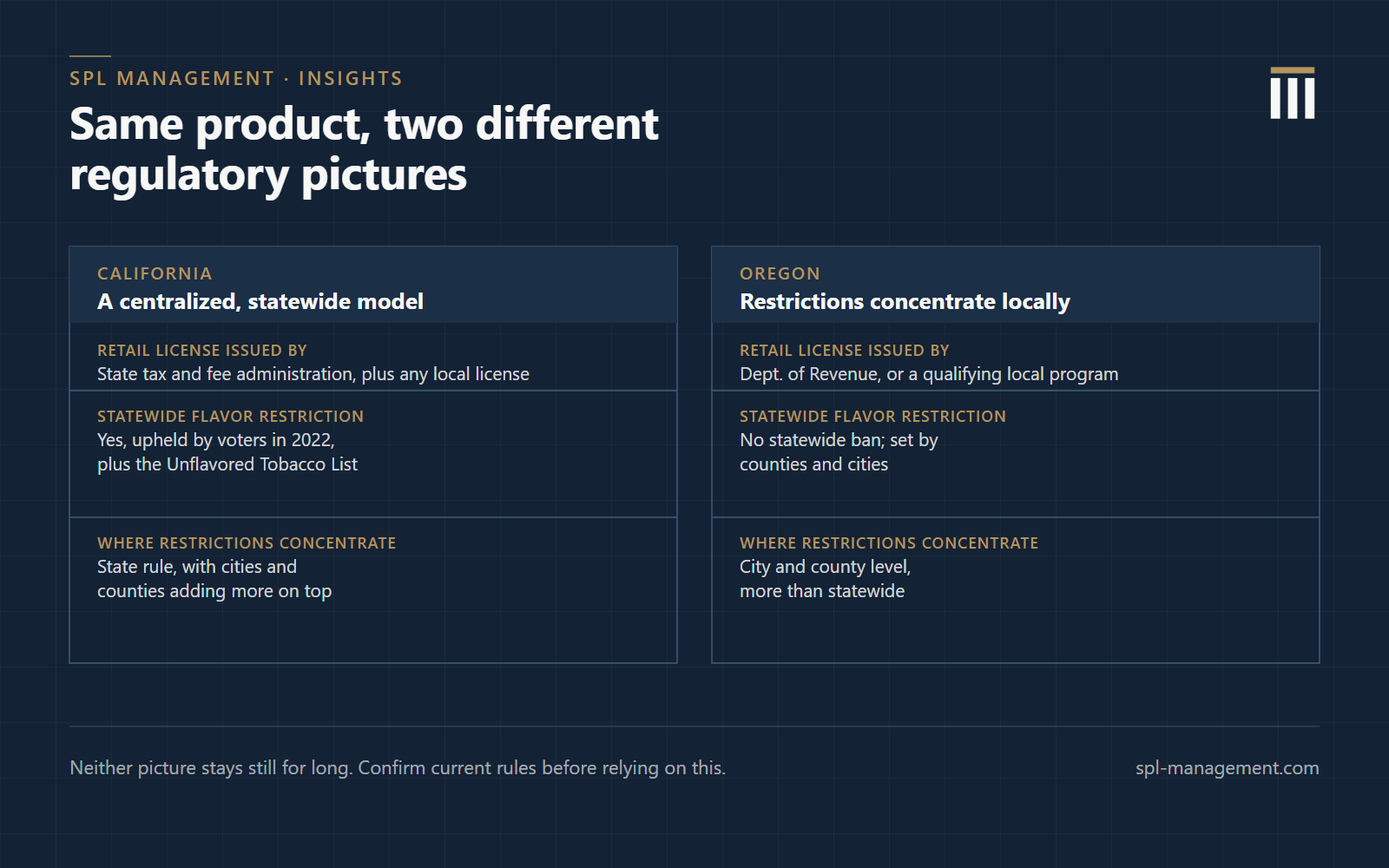
Every retailer that sells cigarettes or tobacco products in California needs a Cigarette and Tobacco Products Retailer’s License from the California Department of Tax and Fee Administration (CDTFA). Each retail location needs its own license, and the license is valid for 12 months. For this license, a tobacco product includes any product containing, made, or derived from tobacco or nicotine that is intended for human consumption, as well as electronic smoking and vaping devices.
The state licensing law does not preempt local tobacco control laws other than those related to collecting state taxes, and it anticipates local licensing laws. In practice, that means a city or county can require its own tobacco retail license on top of the CDTFA license. Check with the city or county for each address.
California: flavor restrictions and the Unflavored Tobacco List
Since December 21, 2022, California has prohibited retailers from selling, offering for sale, or possessing with intent to sell most flavored tobacco products and tobacco product flavor enhancers. According to the California Department of Public Health, that covers menthol cigarettes, flavored e-liquids, flavored smokeless tobacco, and flavored nicotine products. Since January 1, 2025, “nicotine” under the flavor law includes nicotine whether it is naturally or synthetically derived, as well as nicotine analogs and alkaloids. A flavored product containing nicotine is treated as a flavored tobacco product even if it contains no tobacco.
The state law has exceptions. It does not apply to flavored loose-leaf pipe tobacco or to flavored premium cigars with a wholesale price of $12 or more, and flavored shisha may be sold only by a hookah tobacco retailer that meets specific conditions. Where a local ordinance is more restrictive than state law, stores in that jurisdiction must follow the local ordinance.
The Unflavored Tobacco List (UTL) is now the practical shelf check. The Attorney General maintains the list, and any covered tobacco product that does not appear on it is deemed flavored and may not be sold in California. CDPH’s guidance states there is no sell-off period for products not on the list. Products are added on a rolling basis, so check each product against the current UTL before stocking it, and ask the manufacturer or your counsel if you are unsure whether a product is covered.
Oregon: a state license or a qualifying local program
Since January 1, 2022, Oregon has required a tobacco retail license to sell cigarettes, tobacco products, and inhalant delivery systems. Retailers in most of the state get the license from the Oregon Department of Revenue (DOR). Some jurisdictions run their own licensing programs instead. The DOR lists unincorporated Benton, Klamath, and Multnomah counties and certain cities within those counties, including Corvallis, Klamath Falls, Portland, and Gresham. Multnomah County, for example, tells retailers in the county to apply for its license and not to get a second license from the state.
For each Oregon address, confirm whether it falls under DOR licensing or a qualifying local licensing program, and check which agency’s renewal date applies. The DOR describes the state license as valid for one year and renewed annually.
Oregon: SB 1571 and nicotine products
Senate Bill 1571 took effect on June 5, 2026. It expanded Oregon’s definition of “tobacco products” to include oral nicotine pouches, nicotine lozenges, and other products that contain nicotine, and it defines nicotine as any form of the chemical nicotine, whether naturally or synthetically derived. The DOR states that from June 5, 2026, selling oral nicotine products and other non-food products containing natural or synthetic nicotine requires a tobacco retail license.
Under Oregon’s current definition, then, whether a pouch’s nicotine is naturally or synthetically derived does not take it outside the definition. A retailer that added pouches before June 2026 without a tobacco retail license should check its licensing position now. The Oregon Health Authority has said it and local public health authorities will conduct undercover compliance checks that include the updated law.
Oregon: flavor rules are set locally
We did not find a statewide flavored tobacco sales ban in Oregon law as of September 26, 2026. A 2025 bill proposing one, SB 702, remained in Senate committee, and SB 1571 did not add a flavor restriction. Counties are a different matter. Multnomah County adopted an ordinance ending the sale of flavored tobacco and nicotine products, the ordinance has been upheld in court, and the county’s tobacco retail license page reports that the ban stands. Confirm with the county when enforcement applies at your address, and check for any other local flavor rules wherever you operate.
Both states now treat synthetic nicotine as nicotine. The license route, the list of products you may sell, and the local layer still differ, address by address.
What this means for a retailer in both states
A retailer with locations in both states cannot run one shelf standard and expect it to hold everywhere. A workable approach keeps a file for each location that records:
- The licensing authority for the address (CDTFA plus any local license in California; DOR or the qualifying local program in Oregon), with each renewal date
- The product check before a new SKU goes on the shelf: the current UTL and any local ordinance in California, and the county or city flavor rules in Oregon
- The age check staff apply at the register, set to the federal photo ID rule and any stricter state or local requirement
- A named owner and a review date for each item, so changes like SB 1571 are picked up and acted on
Each license and renewal date belongs on a compliance calendar, and our Compliance Calendar Template is a starting point. The register side is covered in our article on point-of-sale age verification and transaction records. Product documentation from suppliers can be checked with the Vendor and Supplier Vetting Checklist, and local caps and moratoriums are covered in our article on local moratoriums and expansion plans.
Sources
- Selling Tobacco Products in Retail Stores, U.S. Food and Drug Administration (accessed September 26, 2026)
- Requirements for Products Made with Non-Tobacco Nicotine Take Effect April 14, U.S. Food and Drug Administration (accessed September 26, 2026)
- Cigarette and Tobacco Products Licensing Act of 2003: Retailer License, California Department of Tax and Fee Administration (accessed September 26, 2026)
- California Business and Professions Code section 22971.3, California Legislative Information (accessed September 26, 2026)
- Frequently Asked Questions: California’s Flavored Tobacco Sales Law (December 2025), California Department of Public Health (accessed September 26, 2026)
- Attorney General Bonta Announces Publication of Unflavored Tobacco List, California Department of Justice (accessed September 26, 2026)
- Flavor Ban, California Department of Justice (accessed September 26, 2026)
- Statewide Tobacco Retail License, Oregon Department of Revenue (accessed September 26, 2026)
- Oregon law expands “tobacco products” definition to prevent underage sales, youth nicotine addiction (June 3, 2026), Oregon Health Authority (accessed September 26, 2026)
- Enrolled Senate Bill 1571 (2026 Regular Session), Oregon State Legislature (accessed September 26, 2026)
- SB 702 (2025 Regular Session) measure overview, Oregon State Legislature (accessed September 26, 2026)
- Tobacco Retail License, Multnomah County (accessed September 26, 2026)
Selling tobacco or nicotine products in more than one state
SPL Management provides compliance management for licensed tobacco, vapor, and nicotine retailers, including tracking licenses, renewal dates, and product checks by location. If you want to talk through how your locations are set up, a consultation is a good place to start. Questions about whether a specific product may be sold go to your counsel and the relevant agency.
General information only, current as of the last review on September 26, 2026. Rules vary by jurisdiction and change often. This is not legal, tax, or real estate advice; confirm current requirements with the regulator or a qualified professional before acting. How we write and review articles.
Keep reading
Compliance
How to Prepare for a Surprise Regulatory Inspection
· 6 min read
Compliance
Regulated Retail Recordkeeping: Retention, Access, and Audit Evidence
· 6 min read
Compliance
Multi-State Cannabis Compliance: What Changes Between Jurisdictions
· 6 min read