Owners in regulated industries eventually face some version of the same question: is this something we handle ourselves, or is it time to bring in outside support? There is no single right answer, and the decision can go wrong in two directions. Some owners wait too long, treating outside help as an admission of failure rather than a normal part of scaling. Others bring in outside support before the work calls for it, when a good internal hire would have been the better fit.
This article is about that sourcing decision. If you are still working out whether there is an oversight problem at all, five signs your regulated business needs stronger oversight covers the symptoms, and the hidden cost of poor compliance management covers what those gaps cost. Here, the question is who should do the work, and how to compare the options.
When internal is the right answer
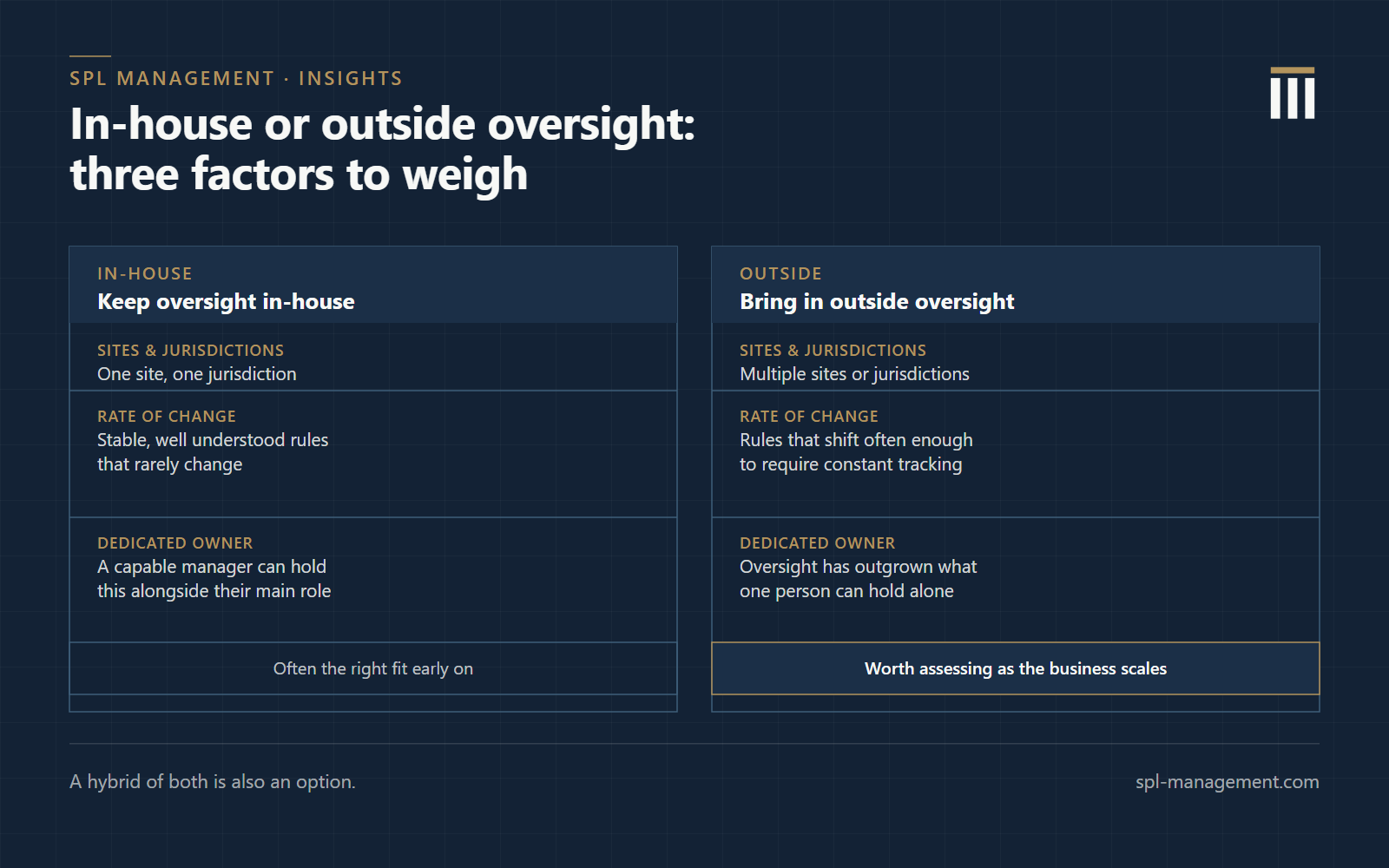
A single location in a stable regulatory environment, with a capable manager and a low rate of change in the applicable rules, may not need an outside operating partner. If the obligations are well understood, the calendar of dates is short enough for one person to own without it becoming their entire job, and the team has been stable for a while, building the function internally can be the more economical choice.
Internal ownership also makes sense when the business is still finding its footing and the priority is speed and flexibility over formal process. Bringing in a structured outside function too early can slow down decisions that a founder or a small team would otherwise make quickly, without adding much protection against risks that have not materialized yet.
When outside support is worth assessing
The calculation changes once a business operates in more than one jurisdiction, adds a second or third site, or faces a regulatory environment where the rules change often enough that keeping current is itself a significant amount of work. At that point, oversight stops being something a busy manager can hold alongside their main role, and starts requiring dedicated capacity, whether that sits inside the company or outside it.
Outside support is also worth assessing around specific events: entering a new jurisdiction with unfamiliar rules, preparing for financing or a sale where regulatory standing will be examined closely, or recovering from a finding that revealed the internal process was not as solid as assumed. In each case, part of the value is having the work done by someone for whom it is the main job rather than an addition to another role.
Three ways to resource the work
“Outside oversight” covers more than one arrangement. Compare the full cost and capacity of an internal hire with the proposed external scope:
- Internal hire. Suits a stable operation with enough recurring work to justify a dedicated role. You get day-to-day presence and knowledge that stays in the business. The full cost includes salary, benefits, recruiting, training, and the management time to supervise the role. Watch for coverage during leave or turnover, and for knowledge that sits with one person.
- Project consultant. Suits a defined piece of work with an end point, such as an assessment, a set of written procedures, or a review of a new market. You get a scoped deliverable, quoted as a project. Watch for what happens after the project ends: someone still has to maintain the calendar and procedures it produced.
- Ongoing management. Suits obligations that recur across sites or jurisdictions and need continued ownership. You get a partner responsible for the agreed tasks and review schedule, set out in a written scope. Watch the scope boundaries: what the partner does, what stays with your team, and what belongs with counsel, accountants, or brokers.
Whichever option you are weighing, the scope should come from facts about the business rather than a general sense of workload:
- The number of sites, jurisdictions, and license types involved
- How many obligations are on the calendar today, and how many are missing from it
- How many of the applicable rules changed in the last twelve months
- Who holds this work now, and how many hours a week it takes from their main role
- The current state of records and written procedures
- Events coming up: a new site, a renewal cycle, financing, or a sale
- Which decisions must stay with the owner, counsel, or other licensed professionals
Bringing in outside support is not an admission that internal management failed. It is a recognition that the obligations have outgrown what one person can hold alongside their main job.
The middle ground
The choice does not have to be all internal or all outside. A hybrid pairs a capable internal point of contact who knows the day-to-day operation with an outside partner responsible for the agreed tasks and review schedule, such as the calendar and the written standards. The internal person is not replaced. Their job changes from carrying the entire burden alone to managing a working relationship with a partner.
This middle ground can fit a business scaling from one or two sites to several, where internal capacity has not yet caught up with the number of obligations already on the books.
Questions worth answering before deciding
A few honest questions can clarify which option fits: How many hours a week does compliance and oversight currently take from someone who has another full-time role? How many of the obligations on the calendar changed in the last twelve months? And if the person currently holding this responsibility left tomorrow, how much would the business know about its own regulatory standing without them?
If the answers point to more work than current capacity allows, that is useful information for the decision, and worth revisiting as the business grows.
Talk through the options
SPL Management works with owners of licensed businesses in the United States and Canada. Ongoing management is a fixed monthly fee, one-time work is quoted as a project, and both are set out in a written proposal. The consultation is a 30-minute call to discuss fit and the next step, including whether an internal option makes more sense for you.
General information only, current as of the last review on September 26, 2026. Rules vary by jurisdiction and change often. This is not legal, tax, or real estate advice; confirm current requirements with the regulator or a qualified professional before acting. How we write and review articles.
Keep reading
Leadership
How to Talk to Your Bank About a Regulated Business
· 4 min read
Leadership
Building a Board or Advisory Group for a Regulated Business
· 6 min read
Leadership
Succession Planning for Owner-Operators in Regulated Industries
· 6 min read