Many small and mid-sized businesses that build an advisory group look for a familiar mix: someone who has scaled a company before, someone with a finance background, maybe a well-connected local name. A regulated business needs those perspectives too, but it also benefits from a kind of advisor a generic group rarely includes: someone with direct experience of the type of regulator this business answers to, and someone who can spot an operational compliance question early.
The terms “board” and “advisory group” get used loosely, so it helps to start with the difference between them. After that: when an advisory group earns its place, what it should cover, and how to keep it light.
An advisory group is not a board of directors
A board of directors is a formal body with legal authority. In a corporation, the governing statute and the company’s own documents set out what the board decides and what its members owe the company. California’s Corporations Code, for example, provides that a corporation’s business and affairs are managed, and its powers exercised, by or under the direction of the board, subject to the statute and the articles. Canada’s federal corporations statute provides that, subject to any unanimous shareholder agreement, the directors manage or supervise the management of the corporation’s business and affairs. Other entity types, such as LLCs and partnerships, allocate authority in their own ways.
An advisory group has no authority of that kind unless the business formally gives it some. Its members offer perspective. They do not approve plans or bind the business. An advisory group can recommend a growth plan; formal approval rests with those holding the relevant authority, whether that is the owner, the members, or a board.
Giving an advisor decision rights, or appointing someone to a formal board, is a governance change. In a licensed business it can also raise disclosure questions with the licensing authority. Ask counsel before making that change.
Why a generic advisory group misses the point here
A typical small-business advisory group focuses on growth advice, financial discipline, and useful connections. Those matter in a regulated business too, but many of its biggest risks and opportunities run through regulatory and compliance questions that a generic advisor is not necessarily equipped to raise.
Without that perspective, an owner can adopt a plan that looks sound on every financial measure and only later discover open questions about whether it can be licensed in the target market. The gap does not show up in the meeting. It shows up months later, when the plan meets local rules or caps nobody thought to check first.
When it earns its place
A single-site business in a stable regulatory environment, run by an owner who knows the rules well, may not need an advisory group yet. The case strengthens once the business is expanding into new jurisdictions, facing a major decision such as financing, a sale, or a new license category, or when the owner realizes they have been making regulatory judgment calls alone for years without anyone checking the reasoning.
The trigger is often not a single event. It is the realization that the decisions have grown bigger than one person’s experience can comfortably cover. Continuity is part of this too: a group that already knows the business is useful if the owner is unexpectedly unavailable, which succession planning for owner-operators covers in more detail.
What each perspective contributes
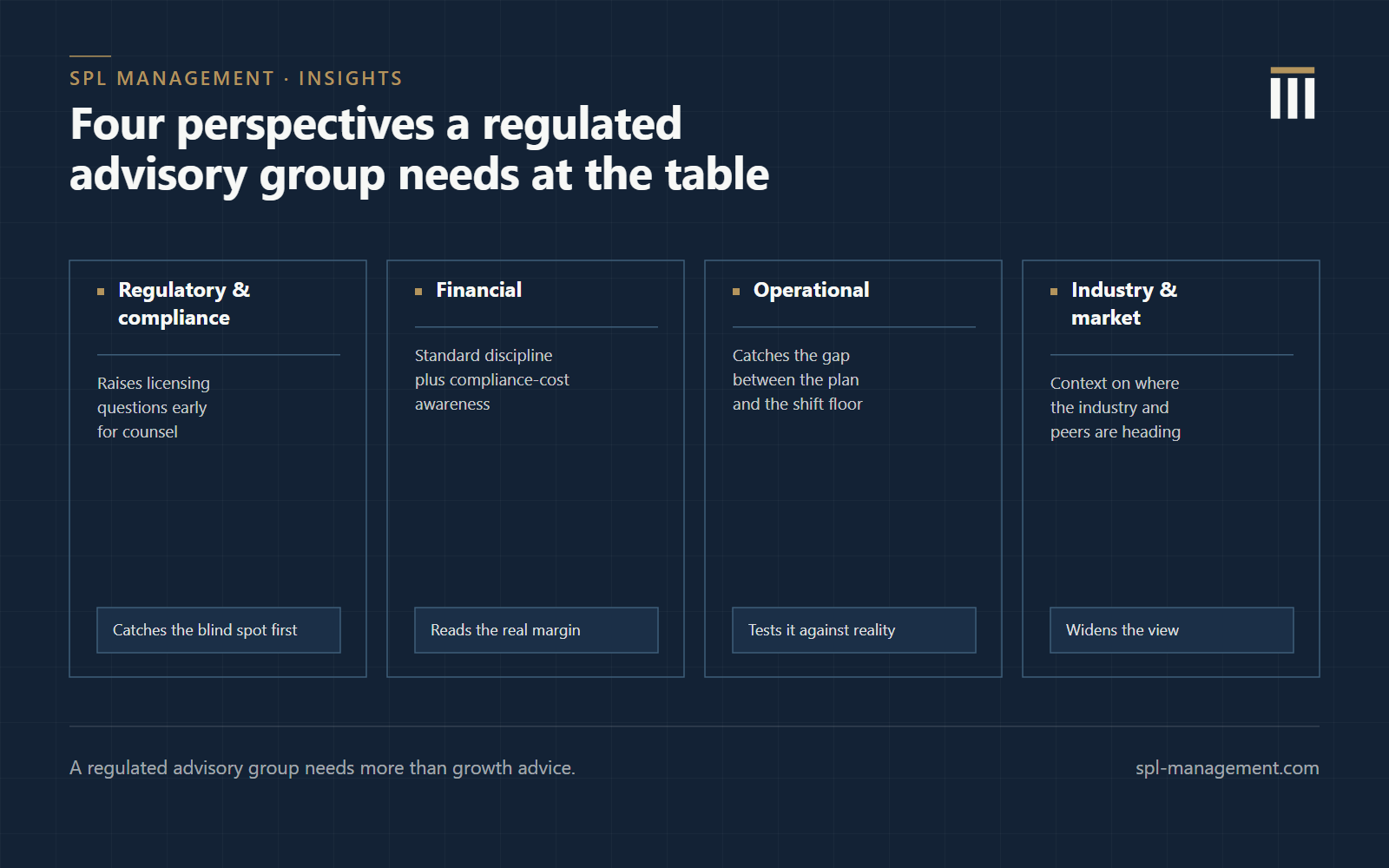
Regulatory and compliance. Someone who has worked with the type of regulator this business answers to can identify the licensing and implementation questions a plan raises, early enough to take them to counsel and the relevant authority before money is committed. Whether a plan is legally permitted is a question for qualified counsel and the authority itself, not for an advisory group.
Financial. Standard financial discipline still applies, and compliance costs and licensing timelines can affect cash flow in ways an ordinary business does not encounter.
Operational. Someone who understands how a plan runs day to day, across sites and shifts, can spot the gap between a decision that sounds simple in a meeting and one that is workable at the counter.
Industry and market. Context on where the industry is heading, and how other operators have handled similar decisions, widens a view that is otherwise focused on one business.
Operational advisors can identify the questions a plan raises. Qualified counsel and the relevant authorities address whether it is legally permitted.
Keep the structure light
For many owners, an informal advisory group is enough to start with, and it avoids the obligations that come with a formal board. Meetings work best when tied to actual decision points rather than a fixed ritual, since the value comes from having the right perspective in the room when a real decision is on the table.
Membership should include at least one person with direct regulatory or compliance experience in the specific industry, since that is the perspective a generic group tends to lack. Agree a few ground rules at the start: how advisors disclose conflicts of interest, for example if one also sells to or invests in the business, and how sensitive compliance and licensing information will be handled. Ask counsel whether a written confidentiality agreement is appropriate before sharing that information.
An advisory group is also different from someone managing the work. Advisors give perspective at decision points; they do not keep the calendar or run the reviews. If the gap is capacity rather than perspective, when to bring in outside oversight is the more relevant question.
Getting started without overbuilding it
The lightest version is two or three trusted outside perspectives the owner consults before major decisions. Formalize further only as the business’s actual complexity, in sites, jurisdictions, or financing activity, calls for it, and with counsel’s input on what formal structure fits your entity.
Revisit who is in the room as the business changes. The right advisor for a single-site operator is not necessarily the right one once the same business operates across several jurisdictions, and a group that made sense two years ago may no longer match the decisions in front of the business today.
Sources
- California Corporations Code, Section 300 (accessed September 26, 2026)
- Canada Business Corporations Act, Section 102 (accessed September 26, 2026)
Prepare for your next major decision
SPL Management is not a law firm and does not make legal determinations. It manages compliance, operations, and licensing timelines for licensed businesses in the United States and Canada, which often includes organizing the information an owner brings to advisors and counsel before a major decision. A 30-minute consultation is a practical way to talk through what that could look like for your business.
General information only, current as of the last review on September 26, 2026. Rules vary by jurisdiction and change often. This is not legal, tax, or real estate advice; confirm current requirements with the regulator or a qualified professional before acting. How we write and review articles.
Keep reading
Leadership
How to Talk to Your Bank About a Regulated Business
· 4 min read
Leadership
Succession Planning for Owner-Operators in Regulated Industries
· 6 min read
Leadership
In-House Compliance or Outsourced Management: How to Choose
· 5 min read