State legalization gets the headlines, and it is easy to build an expansion plan around it. The rules that decide whether a business can open in a specific city can be set locally: a cap on the total number of licenses a jurisdiction will issue, or a moratorium that pauses new applications altogether, adopted by a city council or county board within the authority and limits established by applicable state and local law.
Operators who plan expansion around state law alone are planning around half the picture. Choosing a location for a regulated business sets out the full sequence of checks before signing a lease. This article covers one question in that sequence: whether the market is open to a new license at all, and how to verify it for a specific address.
State legal does not mean locally open
A state license framework sets the outer boundary of what is legal. How much room a city or county has inside that boundary depends on the state’s law. In California, for example, the state cannabis statute says it does not limit a local jurisdiction’s authority to regulate licensed cannabis businesses through local zoning, land use, and business license requirements, or to completely prohibit one or more types of licensed cannabis business within its boundaries. Other states and license types set their own rules on local authority, so the starting point is the state statute and the local code for the address in question.
This is why two operators can hold functionally identical state licenses and have completely different experiences trying to open: one lands in a jurisdiction that allows the use, and the other lands in one that capped it, paused it, or prohibited it before either operator filed an application.
Caps and moratoriums take different forms
Local limits vary from one jurisdiction to the next, which is part of why they get missed. A city might set a numeric cap on total licenses, tie the number to population through a formula, restrict locations so tightly through buffer and density rules that only a handful of parcels qualify in practice, or pause new applications while it studies an ordinance update.
Each version behaves differently for someone planning an expansion. A numeric cap that is already full may open again if a license lapses or, where local rules allow, transfers. A moratorium with no stated end date may not lift for years, or may end once a council finishes its review. Treating these as the same kind of obstacle leads to the same kind of mistake: assuming a market will open on a timeline nobody has confirmed.
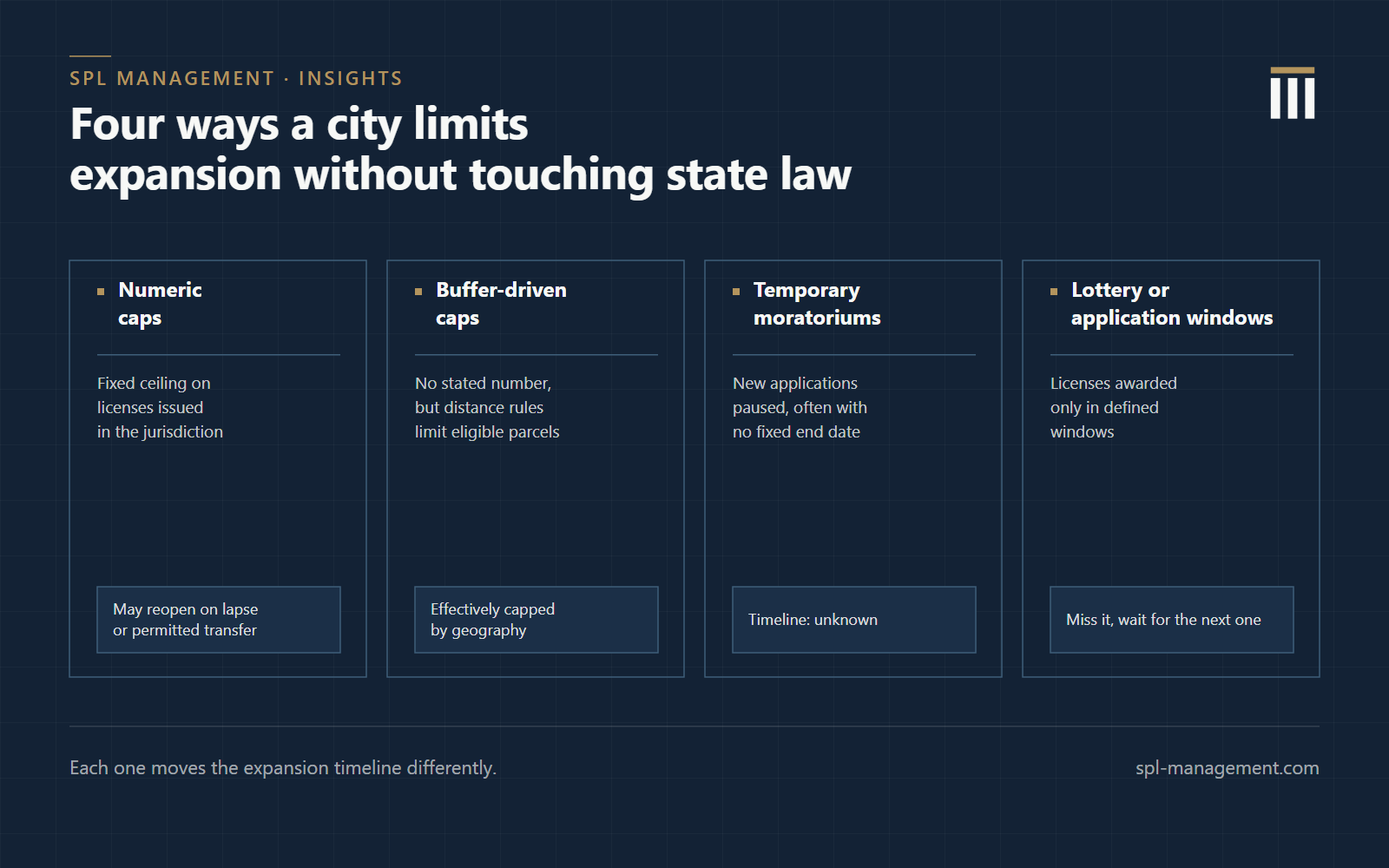
What each type means for your timeline
Numeric caps. A fixed ceiling on the number of licenses a jurisdiction will issue. Once full, the paths in depend on the local rules and may include a lapse, a transfer where permitted, or a future increase to the cap, none of which run on a predictable schedule.
Buffer-driven caps. No stated numeric limit, but distance requirements from schools, parks, or other sensitive uses that can be strict enough to leave only a small number of parcels eligible in practice. The limit is real even though no ordinance calls it a cap.
Temporary moratoriums. A pause on new applications or licenses, often adopted while a jurisdiction drafts or revises its rules. Some carry a stated end date and some do not, and a moratorium adopted as temporary can be extended.
Lottery or application windows. A jurisdiction that accepts applications only during defined windows, then awards a limited number of licenses by lottery or scored review. Missing a window can mean waiting for the next one, on a schedule the jurisdiction controls, not the applicant.
An example of a local limit
The City of Missoula, Montana, shows how one of these reads in practice. Its Ordinance 3786, passed on July 6, 2026 and effective August 5, 2026, added a prohibition on new business licenses for retail adult-use cannabis dispensaries to the municipal code. The city’s cannabis page states that it cannot issue a new or additional adult-use dispensary license through August 5, 2028. The same page describes a narrow exception: an existing licensed dispensary may relocate if its current location closes as a dispensary and the new location complies with applicable regulations.
Two details in that example are worth noticing for any market. The limit has a stated end date, which is useful for planning but can still be extended or replaced. And the exception applies to existing licensees only, so a new entrant’s realistic route in, if any, may be acquiring an existing business rather than applying. Both details came from the city’s own pages, not from a market summary.
A city does not need to ban an industry to close it off. A cap, a buffer, or an open-ended moratorium can have a similar effect more quietly.
What this does to a realistic timeline
Expansion plans built on state legality alone tend to assume a straight line from decision to opening: pick a market, find a site, apply, open. Local caps and moratoriums break that line in ways that are invisible until someone checks for them specifically. A market that looks open on a state licensing map can be effectively closed at the city level, and a site that looks available on a commercial listing can sit on a parcel that does not qualify once buffer rules are applied.
If this surfaces during an application, a letter of intent may already be signed and a deposit committed. The correction at that stage can cost months and, depending on the terms, the deposit.
How to verify local status for an address
Local rules can change faster than public listings and market reports are updated, so confirm status with the jurisdiction itself. A practical sequence:
- Identify each authority. Confirm whether the parcel is inside city limits or in an unincorporated area governed by the county, and whether a local license or permit is required alongside the state license.
- Read the current local code. Find the sections on your license type, then check recent council or board agendas for pending ordinances, moratoriums, or extensions. Note adoption, effective, and end dates.
- Ask in writing. Ask the planning or licensing office whether it is accepting new applications for your license type at that address, whether a cap or moratorium applies, and whether an end or review date is set. Record who answered and when.
- Check the cap position. Where a cap exists, ask how many licenses are issued and available, whether a waitlist or application window applies, and whether existing licenses can be transferred or relocated under local rules.
- Apply zoning and buffers to the parcel. Confirm that the specific parcel qualifies, not just the district.
- Re-check before signing. Status can change between screening and signature, so set a date to confirm again before a letter of intent or lease is signed.
The Site Screening Worksheet has space to record each of these answers alongside zoning and sensitive-use checks. Questions about how an ordinance applies to your situation belong with your counsel.
Start these checks early and build time for unresolved questions into the decision timetable, so the timeline the business plans around is the one the jurisdiction is operating on.
Sources
- California Business and Professions Code section 26200, California Legislative Information (accessed September 26, 2026)
- City of Missoula, City Laws and Regulations: Ordinance 3786 (accessed September 26, 2026)
- City of Missoula, Cannabis: dispensary license prohibition (accessed September 26, 2026)
Talk through a market you are considering
SPL Management helps licensed businesses in the United States and Canada organize the regulatory side of site selection, including gathering local cap and moratorium information from the jurisdiction for review with your counsel, through Real Estate & Facilities Management. If you have a market under consideration, the consultation is a 30-minute call to talk through the checks involved.
General information only, current as of the last review on September 26, 2026. Rules vary by jurisdiction and change often. This is not legal, tax, or real estate advice; confirm current requirements with the regulator or a qualified professional before acting. How we write and review articles.
Keep reading
Real Estate
Due Diligence on a Landlord: Why the Other Side of the Lease Matters Too
· 5 min read
Real Estate
Lease Renewal Preparation for Cannabis and Tobacco Retailers
· 5 min read
Real Estate
Multi-Site Facilities Compliance: What Belongs in Each Site File
· 6 min read