
In an ordinary small business, succession planning is mostly a question of who takes over management and how ownership transfers on paper. In a regulated industry, that is only part of what has to change hands. The license obligations, the compliance knowledge that keeps the business in good standing, and the records of what has been filed with each licensing authority can all sit with one person, and none of that moves automatically when an owner steps back.
This article is about continuity of people and authority: who can act, who is accountable, and what the licensing authority needs to be told when that changes. Site rights, leases, and transaction diligence in a sale are a separate subject. The aim here is a plan that is chosen on a timeline rather than forced by an emergency.
Four different transitions
“Succession” covers several events that raise different questions. It helps to plan for each one separately:
- Emergency absence. The owner is suddenly unavailable, for a week or indefinitely. The question is who can act, sign, and access systems tomorrow.
- Management succession. A new person runs the business while ownership stays the same. The question is whether a change in managers or key personnel has to be reported, and who takes on each duty.
- Ownership change. An owner’s interest moves to a partner, family member, trust, or new investor. The question is whether the change needs notice, a new application, or approval, and whether it can take effect before that happens.
- Sale. The business or its assets are sold to a new party. The question is which licenses and approvals continue and which the buyer must obtain for itself.
What actually has to transfer
Ownership transfer is where succession conversations tend to start, and it is well covered by existing guidance: legal structuring, valuation, tax planning. Three other things matter just as much in a regulated business. The license itself, since a licensing authority may treat a change in ownership or key personnel as an event that requires notice or a new application. The compliance knowledge built up over years about how obligations are tracked and met, which can exist only in the outgoing owner’s memory. And the practical record of the business’s dealings with each authority: who the contacts are, what has been filed, and what is pending.
That last item is a matter of records, not relationships. Maintain accurate ownership and contact records and complete required transition notices or approvals, so that a successor can pick up the file rather than reconstruct it.
How specific the rules can be
What a change requires depends on the license, the jurisdiction, and the kind of change, and the details can be precise. Two California examples show the range:
- The Department of Cannabis Control’s license modification form summarizes its regulations this way: if one or more owners of a cannabis license change, a new license application and fee must be submitted within 14 calendar days of the effective date of the ownership change, and if all owners are transferring their interests, the business may not operate under the new ownership structure until the new application is approved. The same form covers the death or incapacity of an owner, where the owner’s successor in interest must notify the Department in writing within 14 calendar days.
- California’s cigarette and tobacco retailer licensing law states that a retailer’s license is not assignable or transferable.
Other states, provinces, and local licensing programs set their own rules, and rules change. Treat these as examples of how specific the requirements can be, and confirm the current requirements for each license with counsel and the licensing authority.
What belongs in the plan
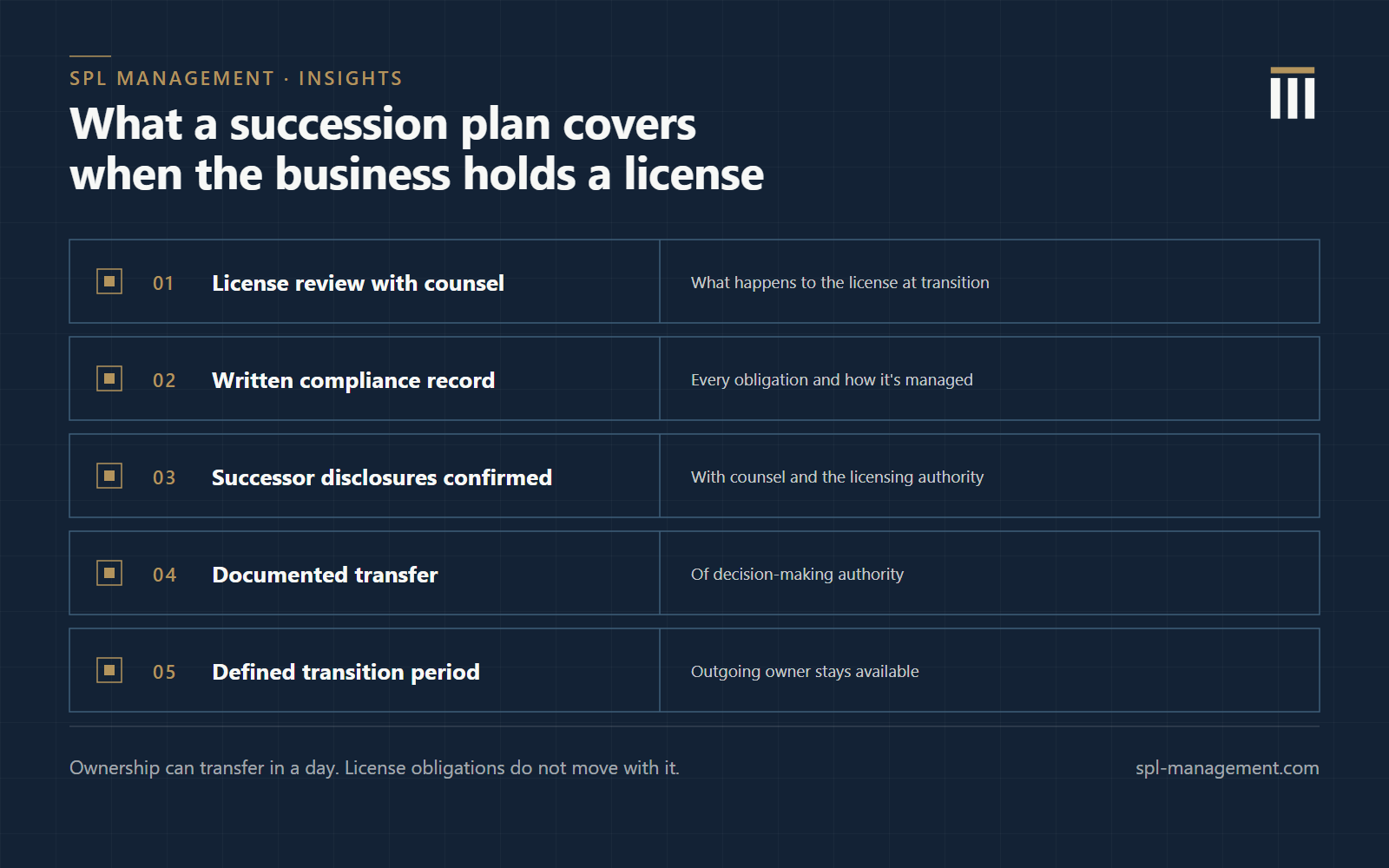
Confirmation of what happens to the license. Before anything else is finalized, confirm with counsel and the licensing authority what a change in ownership or key personnel requires, and how much notice it needs, so the transition does not trigger a lapse or a new application nobody planned for.
A written record of compliance obligations. The licenses, permits, deadlines, and procedures the business currently manages, documented in a form a successor can use, rather than held as institutional memory that leaves the building with the person who has it.
Successor disclosures confirmed in advance. Confirm required successor disclosures and communications with counsel and the licensing authority: who must be listed, what information is required about them, and when any notice or application must be filed.
A documented transfer of authority. A clear, written account of when and how decision-making authority and license responsibilities move to the successor, including signing authority and access to accounts and systems, so there is no ambiguous period where it is unclear who is accountable.
A defined transition period. A set stretch of time where the outgoing owner remains available to the successor and to answer questions, so continuity does not depend on a single hard cutover date.
The Key-Person Handover Plan is a template for the emergency and management cases: duties, owned dates, contacts, systems, and delegated authority. Where ownership is changing, the Change of Ownership Checklist lists the license, lease, permit, and vendor items to review with counsel.
A regulated business does not stop being regulated because the owner is no longer in the room. Succession planning is how the business prepares its license obligations and records for a change in leadership.
What happens without a plan
An abrupt departure, whether by choice, health, or something unplanned, can create immediate uncertainty about license status at a difficult moment. Staff may not know who is authorized to make decisions. Informal knowledge about how obligations are tracked can disappear with the person who held it, and a successor or buyer may inherit a business that looks sound on paper but cannot show how it runs without the person who just left.
A slow scramble to reconstruct what one person used to know can stall operations and delay notices that have their own deadlines.
Starting the conversation before it’s forced
Succession planning works best as an ongoing practice, revisited periodically, rather than a single document filed away. Starting while the owner is still fully active gives the business time to document what currently exists only informally, hand over working relationships with staff, landlords, and vendors gradually, and involve legal counsel early enough to confirm license-specific requirements well before any transition is imminent.
Waiting until a transition is already underway removes the one advantage that makes this manageable: time to do it deliberately instead of under pressure.
Sources
- California Department of Cannabis Control, Notifications and Requests to Modify a License, form DCC-LIC-027 (amended April 2026) (accessed September 26, 2026)
- California Department of Tax and Fee Administration, Cigarette and Tobacco Products Licensing Act, section 22972 (accessed September 26, 2026)
Plan the transition with the right people
SPL Management helps owner-operators of licensed businesses in the United States and Canada prepare the operational and compliance records for a leadership transition, working alongside their attorney and accountant. SPL does not represent clients before licensing authorities. If you would like to talk through what your current plan covers, the consultation is a 30-minute call.
General information only, current as of the last review on September 26, 2026. Rules vary by jurisdiction and change often. This is not legal, tax, or real estate advice; confirm current requirements with the regulator or a qualified professional before acting. How we write and review articles.
Keep reading
Leadership
How to Talk to Your Bank About a Regulated Business
· 4 min read
Leadership
Building a Board or Advisory Group for a Regulated Business
· 6 min read
Leadership
In-House Compliance or Outsourced Management: How to Choose
· 5 min read