A banker who has not worked with a business in your industry has more to learn before they can evaluate it. Unfamiliar terms raise questions, and an owner who walks into that conversation assuming the banker already understands the business may leave the lender with unresolved questions about it. The banker is not being difficult. Unfamiliar risks simply take more work to assess.
Preparation helps in a specific way. It lets a lender evaluate the business on documents rather than impressions, and it saves the lender from having to work out which questions to ask. It does not change the lender’s eligibility rules or its credit decision. That preparation is not about presenting the business as something it is not. It is about making accurate information easy to check.
Start by confirming the lender serves your industry
Before assembling anything, ask whether the institution serves your type of business at all, and on what conditions. Some banks and lenders do not serve certain licensed industries as a matter of policy, and those that do may have their own onboarding, documentation, and monitoring requirements. Eligibility and underwriting are the lender’s decisions, made on its own criteria, and good documentation does not substitute for them.
Ask, too, how the lender wants sensitive documents shared, and use a secure method it approves rather than ordinary email attachments.
Lead with structure, not with the product
A banker does not need a tutorial on the industry. They need to understand how the business is governed: who holds the license, what oversight exists, and what happens if a regulation changes. Framing the conversation around structure and controls, rather than the regulated product itself, moves the discussion onto ground a lender already knows how to evaluate.
Lenders already look at governance and controls in businesses they know well. A regulated operator who presents the same categories, such as licensing structure, oversight, succession, and contingency planning, gives the banker a familiar framework to apply instead of asking them to build one for an industry they rarely see.
Bring the documents that answer the questions
Current licenses with renewal dates marked, a written compliance calendar, and a record of past inspection findings with how each was resolved let a banker check the business’s regulatory standing on paper rather than take it on trust. A short note on who covers key responsibilities if the owner is unavailable, drawn from your succession plan, answers another question lenders tend to have.
Assemble this into a single packet before the meeting rather than promising to send pieces afterward. A complete packet saves follow-up requests and lets your contact present a clearer picture internally. The Bank and Lender Readiness Checklist lists what to gather, and regulated retail recordkeeping covers keeping those records retrievable.
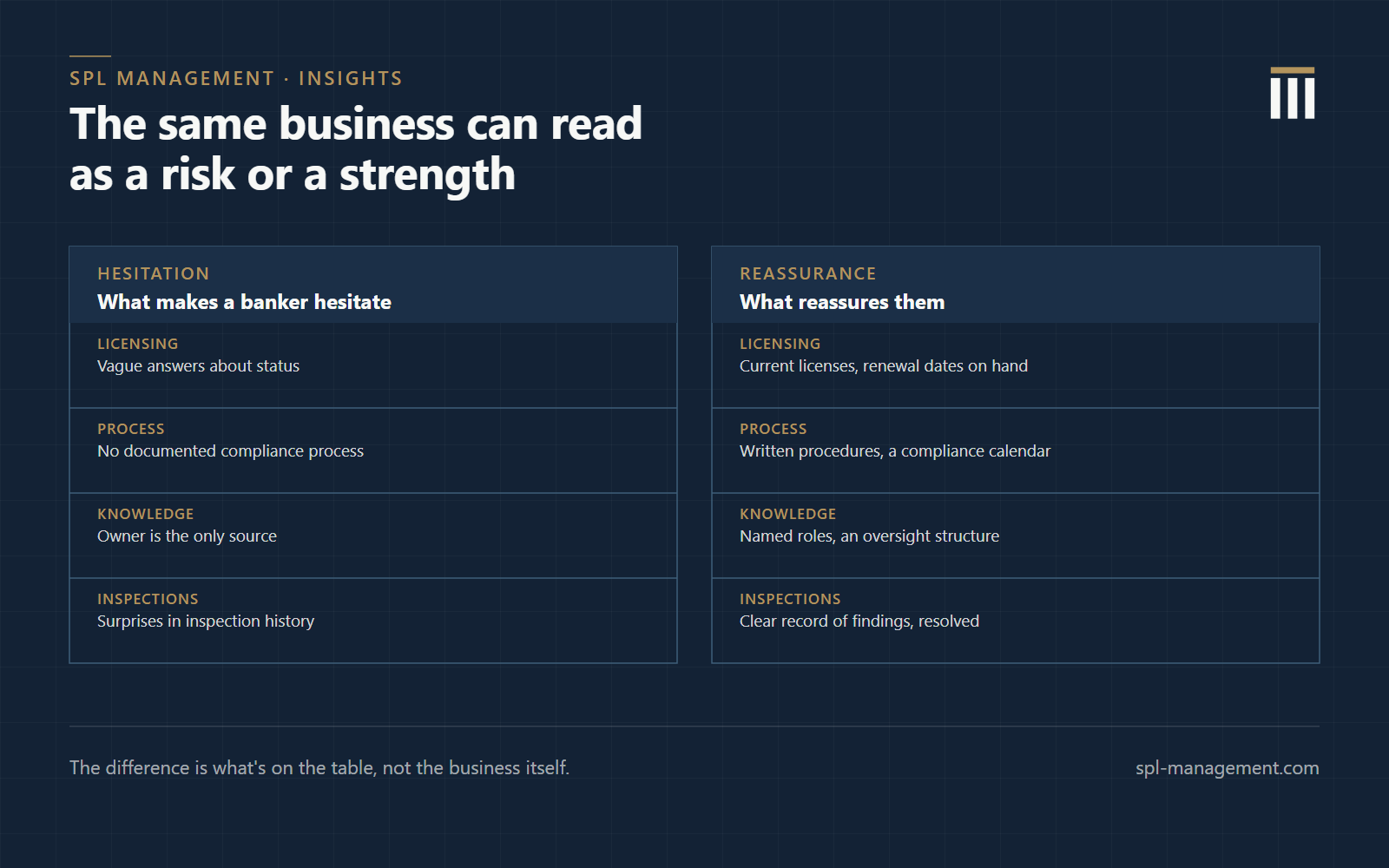
Documents let a lender check what an explanation can only assert.
Present your compliance system as evidence of operating controls
Owners often describe compliance as overhead, a cost of doing business in a regulated space. To a lender, a documented compliance system is evidence of operating controls. It shows how the business manages the obligations behind its license, which is part of what a lender is trying to understand.
Lenders already have a frame for this. They ask manufacturers about quality control and franchisees about brand standards, because controls are part of how they understand operating risk. A regulated operator’s compliance program belongs in the same conversation, presented plainly rather than mentioned in passing.
This works best when the system is already running before the meeting, not assembled the week of it. A banker who asks a follow-up question and gets a fast, specific answer has a different experience from one who gets a promise to look into it.
Building the relationship before you need it
It is easier to have this conversation when the business does not urgently need capital. A lender who has already met the business, seen the compliance calendar, and watched a license renewal happen on schedule has more context when a financing request comes. That preparation may help the lender evaluate the request; eligibility and terms remain its decision.
Regular, low-stakes contact keeps that context current: an annual check-in, a heads-up before a new location opens, an updated compliance calendar. If a regulation shifts or a renewal takes longer than planned, you can then tell the lender early, and in the way your loan documents require, with background it already has. How the lender responds is its decision.
Prepare your documentation before the meeting
SPL Management maintains the compliance calendar, license records, and inspection history that go into a lender packet, as part of Compliance Management for licensed businesses in the United States and Canada. SPL does not arrange financing or advise on lending decisions. A 30-minute consultation is a practical way to talk through what your current documentation shows.
General information only, current as of the last review on September 26, 2026. Rules vary by jurisdiction and change often. This is not legal, tax, or real estate advice; confirm current requirements with the regulator or a qualified professional before acting. How we write and review articles.
Keep reading
Leadership
Building a Board or Advisory Group for a Regulated Business
· 6 min read
Leadership
Succession Planning for Owner-Operators in Regulated Industries
· 6 min read
Leadership
In-House Compliance or Outsourced Management: How to Choose
· 5 min read