On a budget, compliance appears as a line item: license fees, renewal costs, the occasional consultant, and the time it takes to prepare for an inspection. Those costs are visible, and they are budgeted. The expensive part of compliance is what happens when it is managed poorly, and much of that never shows up on the line.
This article is about cost: where it lands, and how to put rough numbers on it. If you are still deciding whether your business has an oversight problem at all, five signs your regulated business needs stronger oversight is the diagnostic companion to this piece.
Compliance failures do not always arrive as a single event
When people imagine a compliance failure, they picture a dramatic moment: a surprise inspection, a large fine, a license suspension. Those things happen. The less visible version is a slow accumulation of small gaps that nobody was assigned to close.
A renewal reminder goes to someone who left the company. A policy is updated at head office but never reaches the second location. A record that should have been kept for three years was kept for one. Each seems minor on its own, but together they can turn a routine inspection into a formal finding.
Poor compliance management does not require anyone to ignore the rules. It only requires the absence of a reliable system for making sure the rules are followed consistently, by whoever happens to be on shift.
The direct costs are only the beginning
The direct costs of a compliance failure are the ones that make the news. Fines, penalties, legal fees, and the cost of remediation are real, and in some regulated industries they can be severe enough to threaten a business. A license suspension, even a short one, can stop revenue while fixed costs continue.
These costs matter, but they are also the easiest to picture and the easiest to dismiss. An owner may reasonably think, “We would never let it get that far.” The trouble is that the costs below can arrive well before anything gets that far.
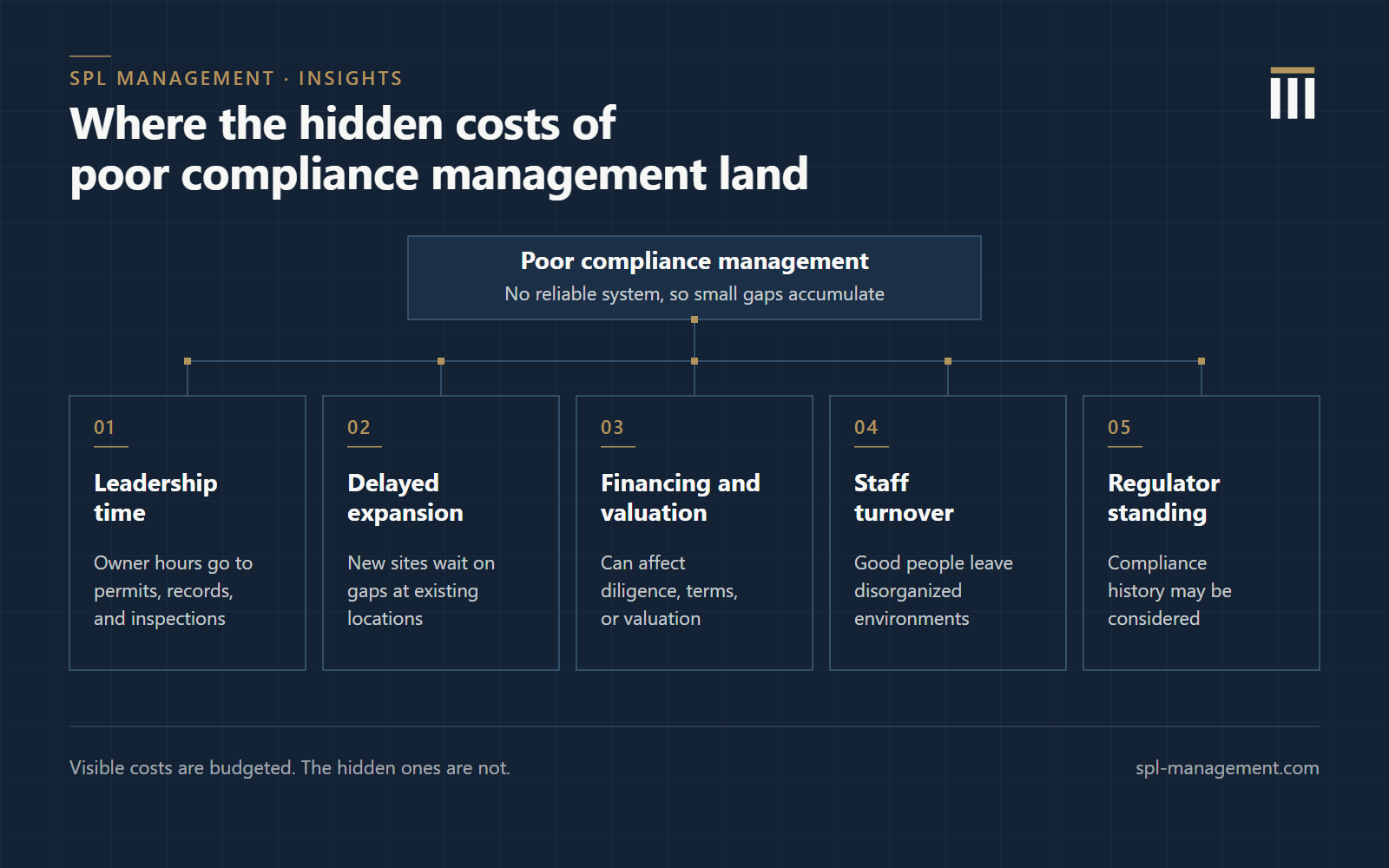
Where the hidden costs live
Poor compliance management does not require anyone to ignore the rules. It only requires the absence of a reliable system for following them consistently.
Leadership time. In a small or mid-sized regulated business, compliance questions tend to land on the owner or a senior executive. Each hour spent chasing a permit status, reconstructing a record, or preparing for an inspection at the last minute is an hour not spent on customers, growth, or the decisions only leadership can make. This is one cost owners can measure by recording time spent on compliance administration.
Delayed expansion. Opening a new location or entering a new jurisdiction may involve review of the operator’s regulatory history, and it needs the capacity to manage a new set of obligations. Businesses with unresolved compliance gaps at existing sites either delay expansion or expand on a shaky foundation. Either way, growth can slow.
Financing and valuation. Lenders, investors, and acquirers may look closely at regulatory standing. Unresolved findings, gaps in records, or a history of late renewals can affect diligence, financing terms, or valuation, depending on the circumstances. A well-documented record is easier to review; a disorganized one can slow diligence at an inconvenient time.
Staff turnover. Employees in regulated businesses can tell when compliance is being handled badly. They see the scramble before inspections and the finger-pointing afterward. Disorganization can contribute to turnover, and each departure brings hiring and retraining time that is worth counting.
Standing with regulators. A regulator may consider prior compliance history where its rules and enforcement policies permit. Late submissions and repeated corrections become part of that history, so they are worth tracking as a cost of their own.
How to put numbers on it
These costs feel abstract until someone counts them. None of them needs a formula; a month of honest record-keeping is enough to see the pattern. Measures worth tracking:
- Leadership time: hours per week the owner or senior staff spend on compliance administration, logged for four weeks
- Expansion delay: weeks a planned site, application, or financing conversation waited on issues at existing sites
- Diligence effort: requests from a lender, investor, or buyer that required reconstructing a record rather than retrieving one
- Turnover: departures from compliance-sensitive roles, plus the hours spent hiring and retraining for them
- Repeat corrections: findings, late submissions, or corrections that recurred within twelve months
A hypothetical example: an owner logs five hours a week on permit status, record requests, and last-minute inspection preparation. Over a year that is about 260 hours, more than six forty-hour weeks, before counting anyone else’s time. Multiply by whatever an hour of the owner’s attention is worth to the business, and the line item looks different.
Why good operators still fall behind
None of this happens because owners do not care. It happens because compliance management is a discipline that requires consistency, and consistency is hard to maintain when it competes with everything else.
A familiar pattern is that compliance is assigned to someone as an additional responsibility on top of a full role. It gets attention when a deadline is close and gets set aside when the business is busy. Over time, the calendar becomes incomplete, procedures drift from what is written, and the gap between how things should be done and how they are actually done widens.
Multi-site operators face a second version of the problem. Each location develops its own way of handling things, and the owner has no reliable way to know whether the written standard is being followed at a given site until an inspector points it out.
What consistent compliance management looks like
The remedy is not more effort. It is a system that reduces the dependence on effort.
A well-managed compliance function has a single maintained calendar covering the licenses, permits, policy reviews, and reporting dates the business has identified, with a named owner for each. How to build a compliance calendar walks through one in detail. Procedures are written in plain language and kept current, and there is a regular review to confirm that what is written is what is happening. Records are organized so that an inspection is a matter of opening a folder, not assembling one.
It also includes someone whose job is to watch for regulatory change and turn it into action in time to prepare before it takes effect. In industries where the rules change often, this is a practical way to reduce surprises.
Finally, it means reporting on a schedule. Owners should know, without asking, what is current, what is coming due, and what needs a decision. That visibility is what turns compliance from a source of anxiety into a routine part of running the business.
Treating compliance as an operating function
The alternative to counting these costs after the fact is to treat compliance as what it is in a regulated industry: a core operating function that deserves the same discipline as finance or sales. Managed that way, it becomes a foundation to build on rather than a cost that surfaces at inconvenient moments.
Whether that function sits inside the business or with an outside partner is a separate decision. In-house compliance or outsourced management sets out how to compare the options.
Talk through where compliance time is going
SPL Management provides Compliance Management for licensed businesses in the United States and Canada. If you would like to review where compliance work sits in your business today and whether outside support makes sense, the consultation is a 30-minute call.
General information only, current as of the last review on September 26, 2026. Rules vary by jurisdiction and change often. This is not legal, tax, or real estate advice; confirm current requirements with the regulator or a qualified professional before acting. How we write and review articles.
Keep reading
Compliance
How to Prepare for a Surprise Regulatory Inspection
· 6 min read
Compliance
Regulated Retail Recordkeeping: Retention, Access, and Audit Evidence
· 6 min read
Compliance
California vs. Oregon Tobacco and Nicotine Retail Rules
· 7 min read