Oversight does not slip in a single morning. The signs arrive gradually, and each one has a reasonable explanation: a renewal was late because the person who tracked it was on leave, or two sites do things differently because their managers came from different backgrounds. The explanations are true, and they are also the problem.
Oversight is the discipline of knowing, at any moment, what is due, who owns it, and whether it was done. When that discipline weakens, the business keeps running for a while on the effort of a few capable people. This article is a diagnostic: five signs that effort has reached its limit. What those gaps cost is covered in the hidden cost of poor compliance management, and who should fix them is covered in in-house compliance or outsourced management.
1. Your week goes to paperwork
The clearest sign is where your own time goes. If you are the person chasing a permit status, pulling records for an inspector, or reading a regulatory bulletin at nine at night, the business is spending its most expensive hour on work a system should carry.
This is not a question of effort. The question is whether the hours go to customers, partners, and decisions, or to the paperwork that keeps the doors open. When administration wins that contest week after week, growth waits.
2. Deadlines have no clear owner
Ask a simple question: who owns the renewal for each license, permit, and lease option you hold, and when is the next one due? If the answer involves an inbox, a spreadsheet someone built two years ago, and a colleague’s memory, the deadline does not have an owner. It has a hope.
Missed dates can come from a reminder sent to someone who left, a calendar never updated after a new site opened, or a filing everyone assumed someone else had handled, rather than from any ignorance of the rules. A single missed date can interrupt operations at a location that was otherwise in good standing.
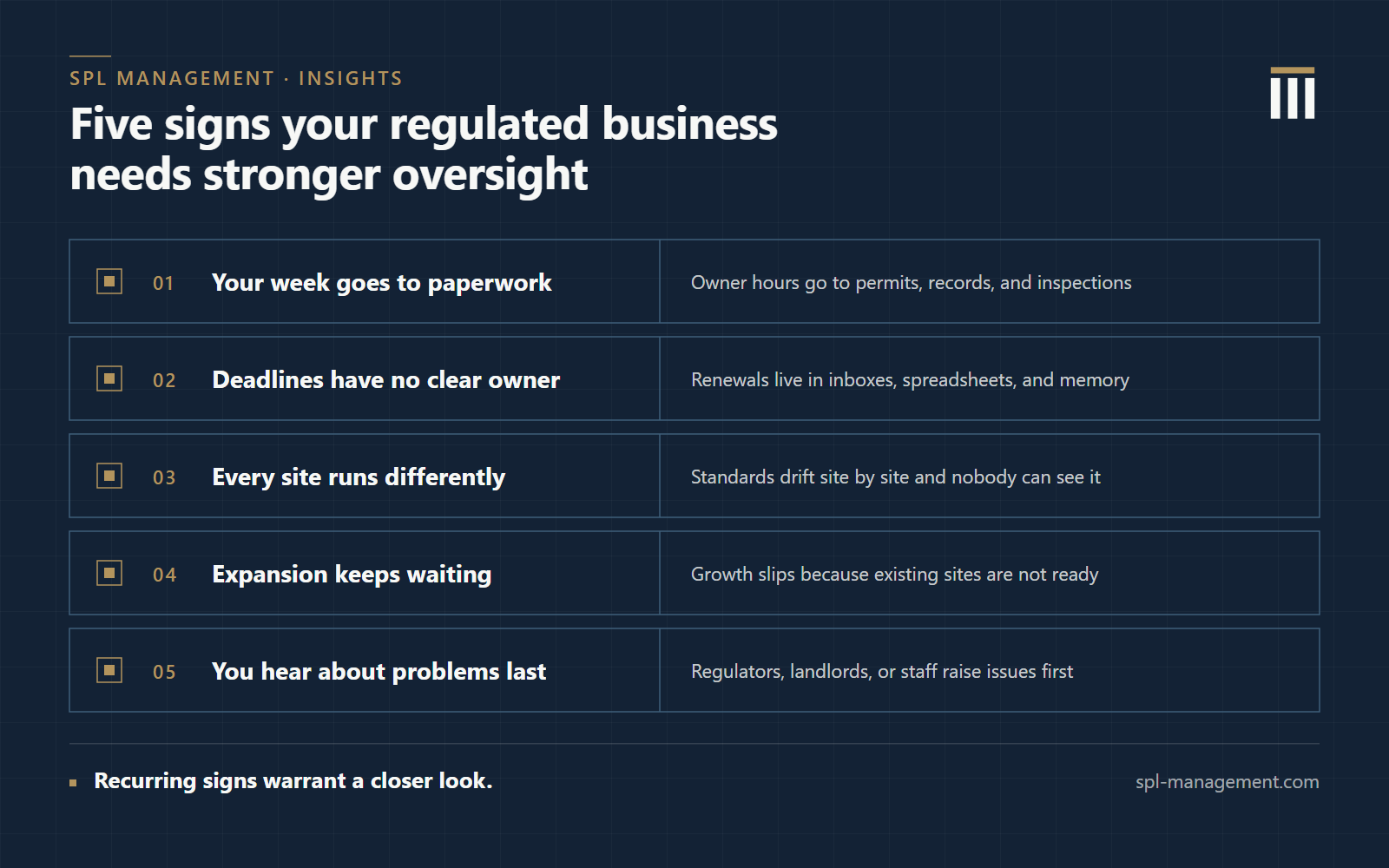
3. Every site runs a little differently
Multi-site operators know this one well. The written procedure says one thing, and each location does its own version: records kept in different formats, training done at one site and skipped at another. Nobody planned the variation; it simply grew.
The trouble is that the variation is invisible from head office until an inspector points it out or a quarter comes in below plan for reasons nobody can explain. If you cannot say with confidence that the standard is being followed at each site today, you have an oversight gap, not a staffing problem.
4. Expansion keeps waiting
Growth in a regulated industry starts from the record you already have. A new license application, a new jurisdiction, or a financing conversation can each invite a close look at how existing sites are run. Unresolved findings, gaps in records, or a history of late filings can lead to delay, added questions, or a harder conversation about value.
If expansion has been on the plan for more than a year and keeps slipping because the current operation is not quite ready, it is worth asking whether the constraint is the foundation rather than ambition or capital.
5. You hear about problems last
The last sign is the one owners feel most. A regulator writes about a late submission, a landlord raises a lease condition that conflicts with a license requirement, or an employee mentions that the last inspection was closer than anyone admitted. Each time, you were the last to know.
Strong oversight produces the opposite experience. Reporting arrives on a fixed schedule, and issues are raised early with options laid out. You know what is current, what is coming due, and what needs a decision, without having to ask.
What stronger oversight actually means
Stronger oversight is not more meetings or a longer list for the same overloaded people. It is a system that does not depend on any one person’s memory or spare time. In practice, it has four parts:
- A single maintained calendar covering the licenses, permits, lease dates, policy reviews, and reporting obligations the business holds, each with a named owner and a lead time (see how to build a compliance calendar)
- Written procedures in plain language that survive staff turnover
- Regular site reviews to confirm that what is written is what is happening
- Someone watching for regulatory change and turning it into action before it takes effect
There is more than one way to put this in place: an internal hire, a consultant for a defined project, or an ongoing management partner. Compare internal capacity, project support, and ongoing management against the work required. In-house compliance or outsourced management walks through that comparison.
Reading the signs together
One of these signs on its own deserves attention. Several recurring signs warrant a closer review of ownership, capacity, and controls. The costs that follow tend to appear gradually, as leadership time, delayed growth, and records that are harder to explain than they should be.
A useful next step is not complicated: a clear picture of where you stand, a plan with owners and dates, and someone accountable for maintaining it on a regular schedule.
Talk through what you are seeing
SPL Management works with owners and operators of licensed businesses in the United States and Canada. The consultation is a 30-minute conversation about your operations, your obligations, and whether stronger oversight is the next step, including whether SPL is the right fit.
General information only, current as of the last review on September 26, 2026. Rules vary by jurisdiction and change often. This is not legal, tax, or real estate advice; confirm current requirements with the regulator or a qualified professional before acting. How we write and review articles.
Keep reading
Leadership
How to Talk to Your Bank About a Regulated Business
· 4 min read
Leadership
Building a Board or Advisory Group for a Regulated Business
· 6 min read
Leadership
Succession Planning for Owner-Operators in Regulated Industries
· 6 min read