Ask a multi-site owner to describe their locations, and they can often do it from memory: the square footage, the layout, roughly when the lease renews. Ask them to confirm, without calling anyone, whether each site’s occupancy approval still matches how the space is used, whether fire and safety inspections are current, and whether signage matches what was permitted, and the confidence can drop. That gap between what an owner believes is true about their facilities and what is true on the ground is what we call facilities drift, and it can grow quietly at any business that operates more than one site.
Facilities drift is not the result of neglect. It happens because facilities obligations, unlike a lease payment, do not send a monthly invoice to remind anyone they exist. This article is about ongoing control: how drift happens, the signs it has set in, and what belongs in the site file that keeps each location current.
How a business loses track of its own locations
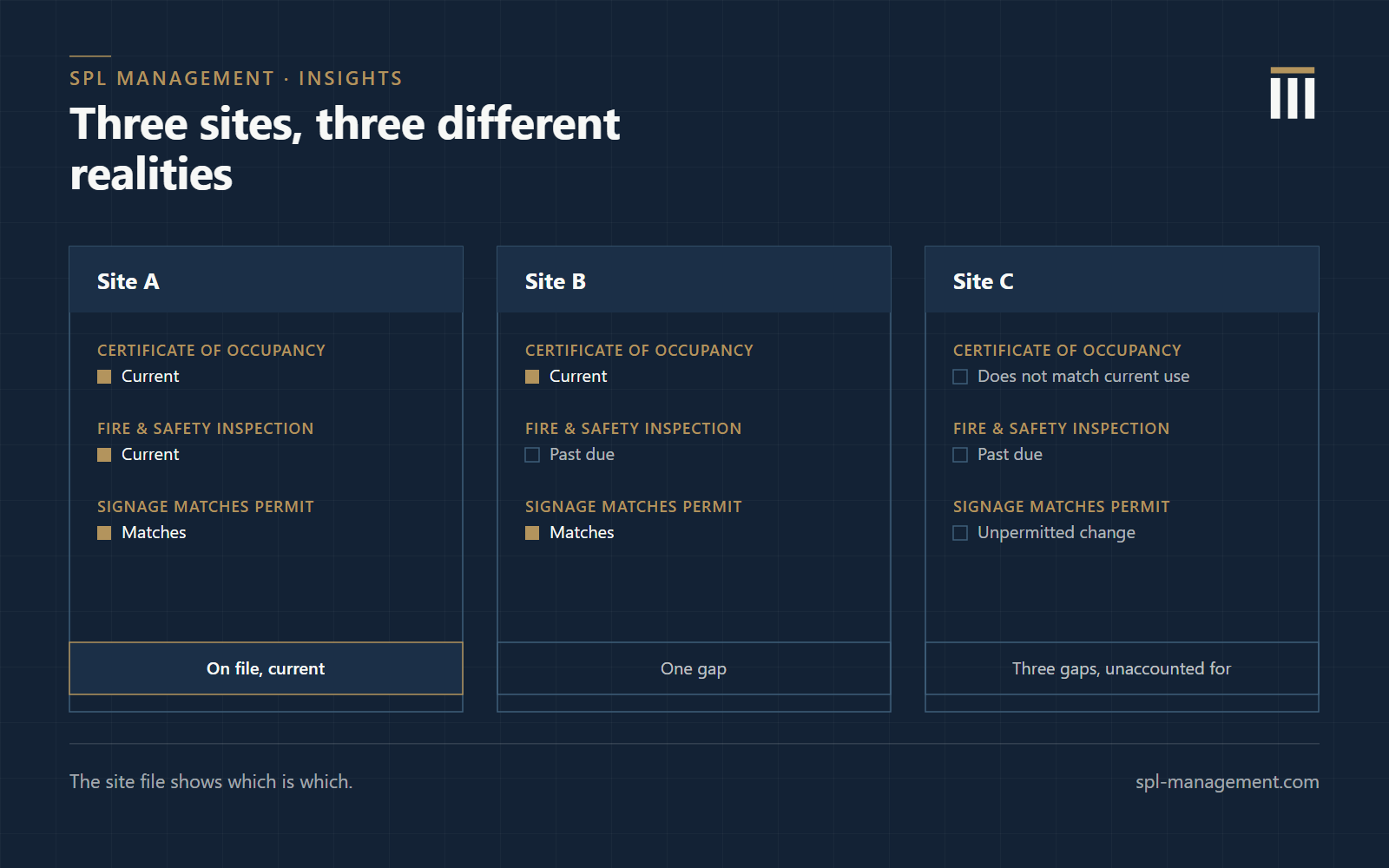
The first site gets close attention. A new business puts real effort into the buildout, the inspections, and the permits for its first location, because everything about it is new and closely watched. By the third or fourth site, that attention can be harder to repeat in full. A local contractor makes a change the original permit did not cover. A fire inspection gets rescheduled and quietly falls off the calendar. A sign is replaced without anyone checking whether the new one still matches the approved permit.
None of these are dramatic events on their own. Each one is a small departure from what is on file with the jurisdiction, and small departures accumulate at any site without someone actively checking. A couple of years later, head office may believe all locations are equivalent when, in practice, no two are exactly alike.
Signs the drift has already set in
A few patterns suggest facilities drift has taken hold. Nobody can produce the occupancy approval for each site without making a phone call first. Fire and safety inspection dates are tracked by memory rather than in a shared record. Signage, buildout changes, and equipment installed after opening day were never checked against the original permit. And when a new manager takes over a location, there is no single file that tells them what that specific site is approved for.
Assess each gap promptly; safety conditions and authorization issues may need immediate action. Several gaps together mean the business no longer has a reliable picture of its own facilities, and that picture tends to get corrected at an inconvenient moment: during an inspection, a lease renewal, or diligence ahead of financing or a sale.
Facilities drift is not neglect. It happens because facilities obligations, unlike rent, do not send a reminder that they still exist.
Occupancy approvals track use, not only dates
An occupancy approval is easy to treat like a license with an expiry date. The more useful question for the site file is whether the approval on record still matches how the space is used and laid out today. Requirements differ by jurisdiction. In the City of Sacramento, for example, the building division states that a certificate of occupancy is required for commercial new buildings, additions, remodels, and tenant improvements where the use of a commercial space has changed. Confirm with the local building department what applies at each address before relying on an older approval.
What belongs in each site file
Correcting drift starts with one file per location, organized the same way at each site so that anyone can find the same document in the same place. A workable index:
- Site summary: address, the entity that occupies the space, the licenses held at that address, and landlord and property manager contacts
- Occupancy approval: a copy of the certificate of occupancy or equivalent approval, with the use and occupancy classification it states
- Approved permit set: building, tenant improvement, signage, and other permits for the site, with final inspection sign-offs
- Change log: each alteration, equipment installation, or signage change since opening, with the permit that covered it or a note that none was obtained
- Fire and safety: the most recent inspection reports, any correction notices, and the date each correction was closed
- Recurring facility items: service and testing certificates the site relies on, where the jurisdiction, insurer, or landlord requires them, with next due dates on the compliance calendar
- Lease cross-references: the use clause, alteration consent requirements, and landlord approvals for the changes in the log
- Open items: each gap found, its owner, the next step, and the date it will be reviewed
- File control: the named owner of the file, a backup, and the date of the last full review
An illustrative discrepancy: Site C’s file shows a signage permit for a wall sign issued when the site opened. A walk-through finds a larger replacement sign installed later, with nothing in the change log. The finding goes on the open items list with an owner, the question for the local permit office is written down, and the file records the date it was raised and the answer when it comes back. The gap is visible and owned rather than discovered by someone else.
Once the file exists, it needs the same maintenance as any other compliance obligation. Renewal and inspection dates belong on the compliance calendar (how to build a compliance calendar covers the format, and the Compliance Calendar Template is ready to use). A routine site walk-through checks the file against the space, and a corrective action log keeps open items from going quiet.
Why this matters more at the wrong moment
Facilities drift is invisible on an ordinary day and costly on the days that matter most. A buyer’s diligence team may review certificates and permits for each site, and gaps found there can complicate negotiations or delay closing. A tenant preparing for a lease renewal is in a weaker position to answer questions if it cannot easily document the condition and approvals of the space. And an unpermitted change found at one site raises the question of whether the others have the same gap.
The work is unglamorous. A business that can produce a current site file for each location on short notice is in a better position to answer a regulator, a landlord, or a buyer than one that has to reconstruct the story after the fact.
Sources
- City of Sacramento, Community Development: Certificates of Occupancy (accessed September 26, 2026)
Talk through your site files
SPL Management tracks facility requirements and coordinates maintenance and corrective work within scope for multi-site licensed businesses in the United States and Canada, through Real Estate & Facilities Management. If you would like to talk through how your site files are kept today, the consultation is a 30-minute call.
General information only, current as of the last review on September 26, 2026. Rules vary by jurisdiction and change often. This is not legal, tax, or real estate advice; confirm current requirements with the regulator or a qualified professional before acting. How we write and review articles.
Keep reading
Real Estate
Due Diligence on a Landlord: Why the Other Side of the Lease Matters Too
· 5 min read
Real Estate
Lease Renewal Preparation for Cannabis and Tobacco Retailers
· 5 min read
Real Estate
Local Moratoriums and Caps: What They Mean for Expansion Plans
· 6 min read