Cannabis is legal in some form in many states, and no two states regulate it in quite the same way. There is no single authorization that substitutes for the state and local approvals required in each market, and since April 2026, federal registration requirements may also apply to medical operators. An operator who runs a well-documented program in one state can enter another and find that the same records, packaging, and standard operating procedures no longer meet the rules there.
This post separates two sets of questions that often get mixed together: federal scheduling and tax, which need their own specialist review, and the state and local operating requirements that change between jurisdictions. It reflects the official sources listed at the end as of September 26, 2026. It is general information, not legal or tax advice.
Federal status is a separate question
A final rule effective April 28, 2026 placed two categories of marijuana in Schedule III of the Controlled Substances Act: marijuana in drug products approved by the FDA, and marijuana subject to a state-issued license to manufacture, distribute, or dispense it for medical purposes. The rule states that any other form of marijuana remains a Schedule I controlled substance.
The same rule created an expedited DEA registration pathway for holders of state medical marijuana licenses. Under it, the state license serves as conclusive evidence of state authorization, a DEA registration cannot exceed the scope of the state license, and the registration is automatically suspended if the state license is suspended, revoked, or expires. These registrations do not authorize activity for non-medical purposes. Separately, the DEA opened a new hearing on June 29, 2026 on the broader proposal to move marijuana to Schedule III. As of September 26, 2026, we did not find a final rule from that proceeding published in the Federal Register.
For an operator with medical licenses, adult-use licenses, or both, the practical step is to record which federal status and registration questions apply to each license, and to review them with counsel.
Tax and banking need specialist advice
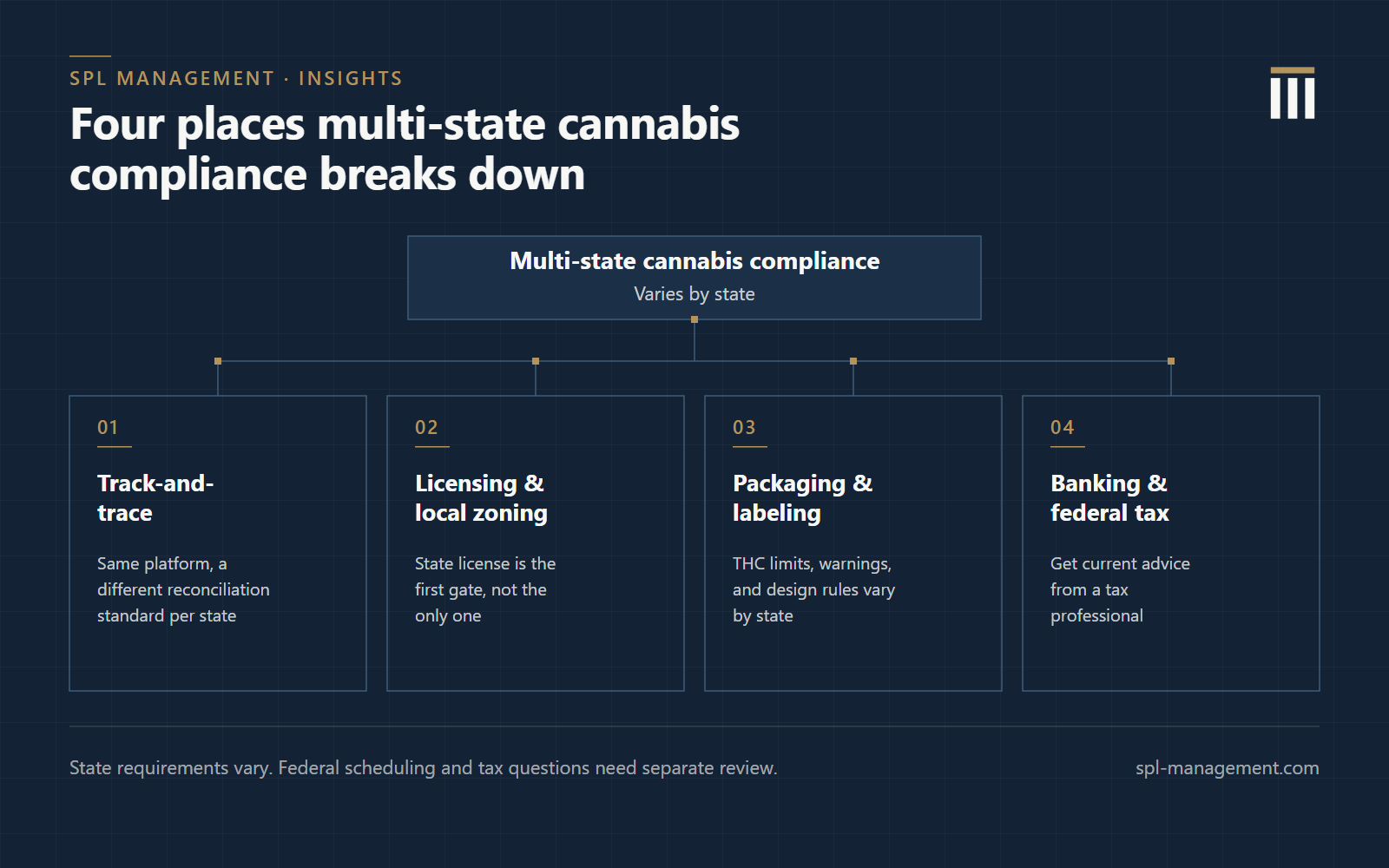
The April 2026 rule discusses Section 280E of the Internal Revenue Code, and it also states that nothing in the rule is a determination of federal tax liability and that state licensees should consult tax counsel. The tax implications depend on the applicable federal rules and the operator’s facts, particularly for operators with both medical and adult-use activity. Obtain current advice from a qualified tax professional before building a budget, a financing plan, or a valuation around any assumed treatment.
Banking is similar. Whether a bank or lender will serve a cannabis business, and on what terms, is that institution’s decision. What an operator can control is the quality of the records it brings to that conversation, which our Bank and Lender Readiness Checklist helps organize.
Track-and-trace: the same software, different rules
State cannabis programs such as California’s and Oregon’s require licensees to report product movement through a state track-and-trace system, and both use the same software vendor. In California, the Department of Cannabis Control (DCC) requires all licensees to use the California Cannabis Track-and-Trace system to track cannabis from seed to sale, and has partnered with Metrc on it. In Oregon, the Oregon Liquor and Cannabis Commission (OLCC) requires all its recreational marijuana licensees and their employees to use its Cannabis Tracking System, which also runs on Metrc.
Familiar software does not mean familiar rules. What counts as a reportable event, how closely weights must reconcile, and how quickly a discrepancy must be corrected are set by each state. Training staff on “how track-and-trace works” in one state and assuming it transfers leaves room for reconciliation gaps in the next. Build the reporting procedure and training for each state from that state’s rules.
Licensing is local as well as state
A state license is the first approval, not the only one. In California, for example, state cannabis law does not limit the authority of a city or county to adopt and enforce its own zoning, land use, and business license requirements for cannabis businesses, or to prohibit one or more types of cannabis business entirely. A market can be open at the state level and closed at the local level.
Other local structures, such as caps on the number of licenses, buffer requirements, and social equity programs with their own eligibility rules and timelines, vary by state and sometimes by city. Confirm the local structure for each proposed address before assuming a standard application process applies. Our article on choosing a location for a regulated business and the Site Screening Worksheet cover the address-level questions.
A program built to be compliant in one state is not automatically compliant in the next. The management framework can travel. The requirements have to be confirmed in each jurisdiction.
Packaging, labeling, and marketing rules differ
Each state sets its own packaging and labeling requirements. California’s DCC, for example, publishes its own child-resistant packaging and labeling requirements for licensees. Details such as THC limits per package and per serving, required warning statements, symbols, and restrictions on imagery that could appeal to minors can differ from one state to the next, and marketing rules add another layer.
A brand sold in several states should check each label against the rules of the state where it will be sold before the packaging is ordered, rather than treating packaging as one national design adjusted only for a logo.
What consistent management looks like across states
The answer is not one national playbook. It is a shared framework with a jurisdiction-specific layer:
- One compliance calendar structure, with a separate set of dates, sources, and owners for each state and locality (the Compliance Calendar Template is a starting point)
- Central procedures with documented local variations, as described in our article on standardizing operations across multiple sites
- One packaging review step that checks every label against the rules of the state where it will be sold
- A record, for each license, of the federal status and registration questions that apply and when counsel and your tax adviser last reviewed them
Sources
- Schedules of Controlled Substances: Rescheduling of Food and Drug Administration Approved Products Containing Marijuana From Schedule I to Schedule III (final rule, April 28, 2026), Federal Register (accessed September 26, 2026)
- Schedules of Controlled Substances: Rescheduling of Marijuana (notice of hearing, April 28, 2026), Federal Register (accessed September 26, 2026)
- Justice Department Places FDA-Approved Marijuana Products and Products Containing Marijuana Subject to a Qualifying State-issued License in Schedule III (April 23, 2026), U.S. Department of Justice (accessed September 26, 2026)
- CannaConnect Licensee Resources, California Department of Cannabis Control (accessed September 26, 2026)
- California Business and Professions Code section 26200, California Legislative Information (accessed September 26, 2026)
- Cannabis Tracking System, Oregon Liquor and Cannabis Commission (accessed September 26, 2026)
Planning for a new state or market
SPL Management provides compliance, operations, and real estate management for licensed cannabis operators, including those working across more than one state or license type. Through our Licensing and Regulatory Strategy work, we prepare a sourced overview of identified requirements and questions for your counsel and the relevant authorities. If you are weighing a new market, a consultation is a chance to discuss what needs confirming, and with whom, before you commit.
General information only, current as of the last review on September 26, 2026. Rules vary by jurisdiction and change often. This is not legal, tax, or real estate advice; confirm current requirements with the regulator or a qualified professional before acting. How we write and review articles.
Keep reading
Compliance
How to Prepare for a Surprise Regulatory Inspection
· 6 min read
Compliance
Regulated Retail Recordkeeping: Retention, Access, and Audit Evidence
· 6 min read
Compliance
California vs. Oregon Tobacco and Nicotine Retail Rules
· 7 min read